

OR Portland
Argay
Argay Terrace is a mid-century planned development in the far northeast corner of Portland, bounded by NE 122nd and NE 148th Avenues between I-84 and the Columbia River. The neighborhood is known for its curving streets and cul-de-sacs, daylight-basement ranches on larger lots, and territorial views of Mount St. Helens and the Columbia River Basin from upper blocks. Luuwit View Park, Columbia Slough trails, and direct access to I-205, I-84, and PDX anchor daily life.





Living in Argay Terrace
A mid-century planned development of curving streets and cul-de-sacs between NE 122nd and NE 148th, with daylight-basement ranches, Columbia River views, and Luuwit View Park at its center.
Updated April 2026 by Joe SalingWhat Argay Terrace Is Really Like
Argay Terrace sits in the far northeast corner of the city, bounded by NE 122nd Avenue on the west, NE 148th Avenue on the east, I-84 on the south, and the Columbia River on the north. The neighborhood was designed in the late 1950s and 1960s by Art Simonson and Gerhardt (Gay) Stavney, who named it by combining the first syllables of their own names. The defining geography is the gently sloping terrain rising up from the river, which gives many upper blocks views of Mount St. Helens, Mount Hood, and the Columbia River Basin. Sandy Boulevard cuts diagonally through the middle, splitting residential Argay to the south from the light industrial and airport-adjacent zone to the north.
A weekday morning in Argay Terrace is the sound of lawn sprinklers, garage doors, and the distant hum of I-205 and PDX departures overhead. Because the street network is built on curves and cul-de-sacs with limited access from the surrounding arterials, the interior blocks stay largely free of through-traffic. The commercial life happens out on the edges: Sandy Boulevard carries a strip of restaurants, 122nd Avenue has Costco and smaller service businesses, and across I-205 the Cascade Station complex (IKEA, Target, Marshalls) anchors larger shopping trips. Weekends shift toward Luuwit View Park and the Columbia Slough trail network on the northern edge.
On residential blocks you will see gardeners working large lots, dog walkers looping the curving streets, and neighbors chatting over low split-rail fences. The Argay Terrace Neighborhood Association is active with park cleanups, pollinator patch events at Wilkes Park, and a welcoming committee for new residents. The southeast corner of the neighborhood includes Argay Downs, a gated 55-plus HOA community with its own clubhouse and pool. Most residential streets have sidewalks and mature street trees, which is less common in outer Portland and reflects the neighborhood's planned-development origins.
Looking for broader context on the area? Read my full East Portland relocation guide for how Argay Terrace fits into the wider district.
Homes and Architecture in Argay Terrace
Argay Terrace's housing stock is almost entirely mid-century, built out from roughly 1955 to 1975 as a single coordinated development. Single-level ranches with basements or daylight basements make up the largest share, followed by split-entry and split-level homes and a smaller number of two-story colonials. Lots run noticeably larger than inner Portland, with many properties on 8,000 to 12,000 square foot parcels, and a few of the upper-elevation lots stretching toward a quarter acre with territorial views. Condominiums and apartments are concentrated around the edges of the single-family core, with Argay Downs, Argay Meadows, and a handful of 1970s and 1980s complexes along the arterials.
When you shop here, expect to see a mix of original and updated condition. Many of the original owners from the 1950s and 1960s held their homes for decades, so some listings come to market with original kitchens, bathrooms, and electrical panels; others have been through one or two rounds of renovation. Competitive dynamics vary with the view and the lot: daylight ranches on upper blocks with Mount St. Helens views draw multiple offers, while standard interior lots negotiate more. Two items worth pricing into your underwriting: original cast-iron sewer laterals now 60 to 70 years old, and original single-pane or early double-pane windows that commonly need replacement. Flood risk is minor at the neighborhood level, though a small share of riverside properties sit in or near the Columbia floodplain and warrant a FEMA map check.
- Mid-century ranch
- Split-entry & daylight basement
- Two-story colonial
- 8,000 to 12,000 sq ft lots common
- Mid-range for East Portland
Geography, Amenities, and Getting Around
Columbia River Bluff & Mountain Views
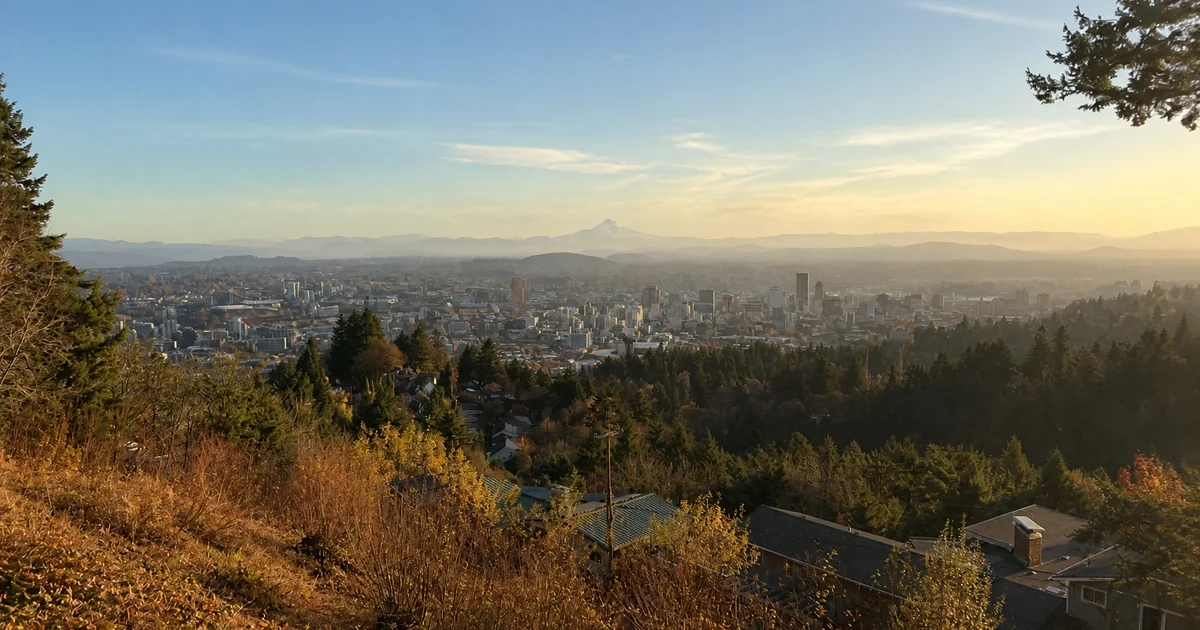
The neighborhood rises from the Columbia River on the north up across gently sloping terrain, giving many upper blocks territorial views of Mount St. Helens, Mount Hood, and the river basin. The Columbia River Slough runs through the northern edge, adding wetland habitat and a trail corridor. View lots are a distinct sub-market here and price accordingly.
122nd & Sandy / Cascade Station
Closest full-service grocery: Costco at NE 122nd and Sandy, plus Safeway at NE 122nd and Halsey, both under 5 minutes by car. Cascade Station (IKEA, Target, Marshalls, Best Buy) sits 5 to 7 minutes west across I-205. Sandy Boulevard carries the local dining (Bistro 23, along with taquerias and Asian restaurants on the 122nd corridor). For hardware and larger errands, Home Depot on Columbia Boulevard is about 8 minutes away.
Luuwit View Park & Argay Park
Luuwit View Park on NE 127th and Fremont is a 16-acre park with an off-leash dog area, skate park, playground, basketball court, and public art installations, and it sits within walking distance of most Argay blocks. Argay Park on 141st is smaller and more local, with additional off-leash areas. The Columbia River bike trail and Broughton Beach are a few minutes north, and Government Island State Recreation Area is accessible by boat across the river.
Getting Around
Freeway access is the neighborhood's real commuting strength. I-205 is 2 minutes away, I-84 runs along the southern border, and PDX is under 5 minutes for departures. Downtown Portland runs about 20 to 25 minutes off-peak, and peak-hour can push closer to 35. TriMet bus lines 21 (Sandy Blvd), 22, and 24 serve the perimeter. The MAX Red Line at Cascade Station is a short drive for direct service to downtown and the airport.
Joe's Take on Argay Terrace
When buyers ask me where they can get a mid-century home on a bigger lot, with real mountain views and direct freeway access, and without paying inner-Northeast prices, Argay Terrace is one of the first neighborhoods I bring up. You get the curving-street, cul-de-sac layout of a planned development, lots that run noticeably larger than the inner-Northeast grid, and a commute to PDX that is effectively zero. The honest trade-off is that Argay is not a walk-to-everything neighborhood. The commercial life sits out on Sandy Boulevard, 122nd Avenue, and across I-205 at Cascade Station, all of which are arterial corridors you drive to rather than stroll along.
The housing stock and location suit buyers who want a larger lot, a single-level floor plan or a daylight basement, and a straightforward drive to the airport or to Washington. It works well for remote workers who do not have a daily downtown commute, for anyone who values view potential, and for buyers focused on 55-plus HOA living in Argay Downs. It is less of a fit if you want to walk to restaurants on a Friday night, or if freeway and flight-path noise bothers you; the two big soundtracks here are I-205 and PDX departures, both of which vary block by block.
Before you write an offer in Argay Terrace, there are a few specifics worth checking. Pull the PDX flight-path overlay for your exact address, since departure and approach tracks cross parts of the neighborhood depending on runway direction and noise varies significantly block to block. Verify the school district, since Parkrose School District covers the neighborhood west of roughly NE 143rd and Reynolds School District covers the blocks east of there, and the boundary matters. Order a sewer scope on any pre-1975 home; cast-iron laterals at this age commonly show cracks and root intrusion. If you are looking at a riverside lot, pull the FEMA flood map; most Argay lots are outside the floodplain, but the northern edge deserves a look. Finally, walk the block on a weekday afternoon to listen for I-205 and flight noise at your specific elevation.
Frequently Asked Questions About Argay Terrace
How do home prices in Argay Terrace compare to the rest of East Portland?
Argay Terrace typically prices in the middle to upper range of East Portland. The mid-century housing stock on larger lots, the view premium on upper blocks, and the planned-development layout with sidewalks and curving streets all push prices up relative to the denser East Portland neighborhoods to the south. Expect to pay more than Powellhurst-Gilbert, Centennial, or Glenfair on a per-square-foot basis, and roughly in line with or slightly below parts of Parkrose and Russell. View lots with Mount St. Helens or river orientation sit at the top of the range. The current average sales price and active listing count are shown at the top of this page and update automatically with the market.
What are property taxes like in Argay Terrace?
Multnomah County property taxes in Argay Terrace run at an effective combined rate of approximately 1.3% to 2.1% of assessed value, in line with the rest of the county. The actual rate and tax bill for any specific address depend on the school district (Parkrose on the west side of the neighborhood, Reynolds on the east) and any local bond measures in effect. Oregon Measure 50 caps assessed value growth at 3% per year, so long-held homes often pay less than their market value would suggest. Verify current rates and the specific assessment for any address you are considering at multco.us/assessment-taxation.
Which schools serve Argay Terrace?
Argay Terrace is split between two school districts. Addresses west of roughly NE 143rd Avenue fall in the Parkrose School District, with Shaver Elementary (located inside the neighborhood on NE 131st), Parkrose Middle School, and Parkrose High School as the default assignments. Addresses east of that line fall in the Reynolds School District, with Margaret Scott Elementary, H.B. Lee Middle School, and Reynolds High School. The two districts rate differently on GreatSchools and Niche, so the boundary line is worth checking before writing an offer. Verify the specific address assignment at parkrose.k12.or.us or reynolds.k12.or.us.
What is the housing stock like in Argay Terrace?
Housing stock is almost entirely mid-century, built out from roughly 1955 to 1975. Single-level ranches with basements or daylight basements dominate, followed by split-entry and split-level homes and a smaller number of two-story colonials. Lots tend to run 8,000 to 12,000 square feet, larger than most Portland neighborhoods of similar vintage, with some upper-elevation lots approaching a quarter acre. The southeast corner of the neighborhood includes Argay Downs, a gated 55-plus HOA community with clubhouse amenities. Most residential streets have sidewalks and mature street trees, a legacy of the planned-development design.
How long is the commute from Argay Terrace to downtown Portland?
Downtown Portland is typically 20 to 25 minutes by car outside of peak hours, using I-205 south to I-84 west. Peak-hour drives can push closer to 35 minutes, and accidents on either freeway can extend that further. For transit commuters, the MAX Red Line at Cascade Station (about 5 minutes by car) runs direct to downtown in roughly 30 to 35 minutes. PDX is under 5 minutes away, which is a significant feature for anyone who travels for work.
Is Argay Terrace walkable?
Argay Terrace is not a walkable-to-restaurants neighborhood in the inner-Portland sense. The commercial life sits out on Sandy Boulevard, NE 122nd Avenue, and across I-205 at Cascade Station, all of which are arterial corridors. What the neighborhood does have is walkable residential character: sidewalks on most interior streets, mature street trees, and a park within walking distance of most blocks. Walk Scores generally run in the 30s to 50s depending on proximity to Sandy. The strongest walking infrastructure is the Luuwit View Park area and the Columbia Slough trail network on the northern edge.
How does Argay Terrace compare to nearby East Portland neighborhoods?
Argay Terrace sits at the higher end of the East Portland range. Compared to Parkrose directly across I-205 to the west, Argay has larger lots, a more coordinated mid-century housing stock, and the view premium on upper blocks; Parkrose has more 1940s and 1950s housing variety and easier access to the MAX. Compared to Centennial and Glenfair further south, Argay prices above both, has more sidewalks, and offers views that those neighborhoods do not. Russell to the southwest is similar in vintage but lacks Argay's river orientation. Argay Terrace is the pick when a buyer wants the mid-century architecture, the larger lot, and the view potential, and is willing to pay a premium for the planned-development character.
Can I add an ADU or short-term rental in Argay Terrace?
Most Argay Terrace single-family lots are eligible for an accessory dwelling unit under Portland's Residential Infill Project rules, which allow up to one ADU on a single-family lot. The larger lot sizes here can make ADU construction more flexible than in denser Portland neighborhoods. Lots inside the Argay Downs gated HOA follow HOA rules and typically do not allow ADUs or short-term rentals. Short-term rentals require a City of Portland STR permit; Type A permits require owner-occupancy, and Type B permits (non-owner-occupied) have stricter limits and are harder to obtain. Verify both ADU eligibility and STR permit type for your specific address with Portland Bureau of Development Services (portland.gov/bds) before counting on rental income.
Thinking About Buying in Argay Terrace?
I help buyers navigate East Portland neighborhoods every week. Let's talk about what you need, what you can afford, and whether Argay Terrace is the right fit.
Schedule a Free Consultation Or call Joe directly: (503) 910-7364Joe Saling · Saling Homes at eXp Realty · 10+ years serving Portland metro buyers and sellers
Saling Homes at eXp Realty is committed to the principles of the Fair Housing Act and Equal Housing Opportunity. Licensed in the State of Oregon. Information deemed reliable but not guaranteed. Verify all data independently before making real estate decisions.
MY BLOGS

MARKET TRENDS

HOUSING DETAIL
NEARBY SCHOOL & BUSINESS
3812 NE 134TH AVE, Portland, OR 97230
Single Family Home 5 Beds 3 Baths 3,508 SqFt
Listed by Real Broker
4134 NE 131ST PL NE, Portland, OR 97230
Single Family Home 5 Beds 3 Baths 2,979 SqFt
Listed by Keller Williams PDX Central13921 NE SISKIYOU CT, Portland, OR 97230
Single Family Home 5 Beds 3 Baths 2,400 SqFt
Listed by MORE Realty13257 NE FREMONT ST, Portland, OR 97230
Single Family Home 4 Beds 3 Baths 2,600 SqFt
Listed by MORE Realty14547 NE STANTON CT, Portland, OR 97230
Townhouse 2 Beds 2.1 Baths 1,874 SqFt
Listed by John L. Scott14448 NE SHAVER ST, Portland, OR 97230
Single Family Home 4 Beds 3 Baths 2,111 SqFt
Listed by MORE Realty4230 NE 125TH PL, Portland, OR 97230
Townhouse 2 Beds 2 Baths 1,219 SqFt
Listed by Berkshire Hathaway HomeServices NW Real Estate13710 NE BEECH ST, Portland, OR 97230
Single Family Home 4 Beds 2 Baths 1,896 SqFt
Listed by Bohrer Realty3948 NE 135TH AVE, Portland, OR 97230
Single Family Home 4 Beds 3 Baths 1,964 SqFt
Listed by Alameda Realty LLC3360 NE 133RD AVE, Portland, OR 97230
Single Family Home 4 Beds 3 Baths 2,211 SqFt
Listed by Neighbors Realty14141 NE FREMONT CT, Portland, OR 97230
Single Family Home 3 Beds 3 Baths 3,076 SqFt
Listed by John L. Scott Portland Metro13918 NE KLICKITAT CT, Portland, OR 97230
Single Family Home 4 Beds 2 Baths 1,772 SqFt
Listed by Oregon First4246 NE 125TH PL, Portland, OR 97230
Townhouse 2 Beds 2 Baths 1,219 SqFt
Listed by RE/MAX Equity Group12640 NE FREMONT ST, Portland, OR 97230
Single Family Home 5 Beds 3 Baths 2,402 SqFt
Listed by Coldwell Banker Bain3431 NE 132nd AVE, Portland, OR 97230
Single Family Home 3 Beds 1.1 Baths 1,161 SqFt
Listed by Lovejoy Real Estate12509 NE BEECH ST, Portland, OR 97230
Single Family Home 4 Beds 2.1 Baths 2,472 SqFt
Listed by Urban Pacific Real Estate14622 NE ROSE PKWY, Portland, OR 97230
Townhouse 3 Beds 2 Baths 1,966 SqFt
Listed by Premiere Property Group, LLC3237 NE 131ST AVE, Portland, OR 97230
Single Family Home 4 Beds 3 Baths 3,632 SqFt
Listed by Oregon First3909 NE 135TH AVE, Portland, OR 97230
Single Family Home 6 Beds 3 Baths 2,825 SqFt
Listed by Matin Real Estate3130 NE 142ND AVE, Portland, OR 97230
Single Family Home 5 Beds 3 Baths 1,901 SqFt
Listed by MORE Realty

Coming Soon
Commute Score
Coming Soon
Coming Soon
DEMOGRAPHICS
Population:
Density:
Households:
Gender
Coming Soon
Coming Soon
Coming Soon
Coming Soon

Joe Saling
joe@sellingpdxhomes.com