

Living in Portland, Oregon:
Your Complete Neighborhood Guide
Seven districts. Ninety-five neighborhoods. One guide built by a lifelong Oregonian who has researched every corner of this metro.
Portland, Oregon is a city of 660,000 residents (2.5 million metro) where your neighborhood choice shapes your daily life more than almost any other factor. The city sits at the confluence of the Willamette and Columbia Rivers in northwestern Oregon, 70 miles inland from the Pacific Coast and 60 miles west of Mount Hood. Ocean beaches, alpine skiing, and Columbia River Gorge hiking are all within 90 minutes of downtown.
Unlike Beaverton or Hillsboro, where neighborhoods blend into commercial corridors along main highways, Portland's 95 neighborhoods developed around independent commercial streets that still function as walkable main streets today. Hawthorne, Alberta, Mississippi, NW 23rd, and Division each have their own restaurants, shops, and identity. The Willamette River splits the city east and west, and that division is more than geographic. The west side holds downtown, the Pearl District, and the wooded hills of the Southwest. The east side spreads across a flat grid of residential neighborhoods, each organized around its own commercial corridor.
Downtown Portland has been through a post-pandemic reset, with increased commercial lease activity in 2025-2026 signaling a recovery that is slower but measurable. Oregon's Urban Growth Boundary concentrates development inside city limits, which means the infill construction you see on Division Street and in the Foster-Powell corridor is the market's response to constrained land supply, not suburban sprawl.
This guide breaks Portland into seven geographic districts, covers every neighborhood with current pricing and trade-offs, and gives you the honest picture of what living here actually looks like. I have been selling homes across this metro for 10+ years, and the information below is what I would tell you if we were sitting across the table at a coffee shop on Hawthorne.
Portland at a Glance
Portland's overall cost of living is approximately 15-20% above the national average, driven primarily by housing costs. The median home price sits around $525,000 for a single-family home, ranging from the low $300s in East Portland to over $1 million in the SW Hills, Alameda, and Irvington. Rent for a one-bedroom apartment in inner Portland typically runs $1,400-$1,800 per month, with two-bedroom units averaging $1,700-$2,400 depending on neighborhood.
Oregon has no sales tax, which makes everyday purchases noticeably cheaper than in neighboring Washington. Groceries run roughly 5-10% above the national average, with the gap narrowing if you shop at WinCo, Grocery Outlet, or one of Portland's many farmers markets. Utility costs (electric, gas, water, garbage) average $250-$350 per month for a three-bedroom home. Portland General Electric and Pacific Power serve different parts of the metro, so rates vary by address.
The tax picture requires careful attention. Oregon's top state income tax rate is 9.9% (kicking in at $125,000 for single filers), and Multnomah County adds a 1.5% Preschool for All tax on income above $125,000 (single) or $200,000 (joint). Metro's Supportive Housing Services tax adds another 1% above those same thresholds. Property taxes average 1.1-1.3% of assessed value in Multnomah County, but Oregon's Measure 50 caps annual assessed value growth at 3%, so long-term homeowners often pay taxes on assessments well below market value. New buyers should expect their assessed value to reset closer to purchase price.
Compared to Seattle, Portland's housing costs are roughly 30-35% lower for equivalent neighborhood quality, and the absence of sales tax offsets some of the income tax burden. Compared to Austin and Denver, Portland's housing is broadly similar, but Portland's higher state income taxes are a significant factor for dual-income households earning above $200K. For buyers relocating from California's coastal metros, Portland represents a substantial cost reduction on housing with comparable quality of daily life in inner neighborhoods. For a closer look at housing costs in specific suburban communities, see our guides to Lake Oswego, Beaverton, and Happy Valley.
Data current as of April 2026. Prices and tax rates subject to change.
Back to guidePortland has a marine West Coast climate with mild, wet winters and warm, dry summers, averaging 154 rainy days and 36 inches of rainfall per year. The rain pattern is the defining feature of daily life here: October through June brings persistent overcast and steady drizzle, while July through September delivers stretches of 80-90 degree days with low humidity and some of the most pleasant summer weather in the country.
| Month | Avg High | Avg Low | Rain (in) | Rainy Days | Character |
|---|---|---|---|---|---|
| January | 47°F | 36°F | 4.9 | 18 | Gray, occasional snow |
| February | 51°F | 37°F | 3.7 | 15 | Gray, early bulbs |
| March | 56°F | 39°F | 3.7 | 17 | Warming, still wet |
| April | 61°F | 42°F | 2.7 | 15 | Cherry blossoms, mixed |
| May | 67°F | 47°F | 2.1 | 13 | Green, drying out |
| June | 73°F | 52°F | 1.5 | 9 | Summer begins |
| July | 81°F | 57°F | 0.5 | 3 | Dry, warm, long days |
| August | 82°F | 57°F | 0.4 | 3 | Peak summer, possible smoke |
| September | 76°F | 52°F | 1.1 | 5 | Warm, dry, golden |
| October | 63°F | 45°F | 3.0 | 13 | Fall color, rains return |
| November | 52°F | 40°F | 5.4 | 18 | Wettest month, gray |
| December | 46°F | 35°F | 5.5 | 19 | Short days, cold rain |
The honest reality of Portland weather is that the rain is not the problem. Portland gets less total rainfall than cities like New York, Atlanta, and Houston. The challenge is the duration of gray. The overcast season runs roughly late October through mid-June, with stretches of 10-14 days without seeing direct sun. For buyers relocating from sunnier states, this is the number one lifestyle adjustment. Some people love it (you never need to water your lawn). Others find the gray genuinely difficult.
Wildfire smoke has become a late-summer factor since 2017. Most years see 1-3 weeks of degraded air quality in August or September when fires burn in the Cascades, Central Oregon, or Northern California. On the worst days, outdoor activity is not recommended. This has made air conditioning (or at least a heat pump with filtration) a practical upgrade rather than a luxury. Many older Portland homes were built without AC, so inspecting the HVAC system is a priority for any home built before 2010.
Portland summers, when they arrive, are the payoff. Late June through September offers long days (sunset past 9 PM in June), temperatures in the upper 70s to mid 80s, and outdoor dining, hiking, and festivals on a scale that makes the winter tolerable. Most Portlanders will tell you the summers are what keep them here.
Back to guidePortland's economy is anchored by technology, healthcare, athletic and outdoor brands, and manufacturing, with a median household income of approximately $78,000 and a growing remote-work sector that has reshaped the housing market since 2020.
The largest employers in the Portland metro include Intel (Hillsboro campus, approximately 22,000 employees and the state's largest private employer), Nike (Beaverton world headquarters), OHSU (Oregon Health and Science University, Portland's largest employer within city limits), Providence Health, Kaiser Permanente, Columbia Sportswear (downtown Portland headquarters), Daimler Trucks North America (Swan Island headquarters), Adidas North America (North Portland), and Precision Castparts (a Berkshire Hathaway company based in Portland). The tech sector extends beyond Intel to include companies like Lattice Semiconductor, Mentor Graphics (Siemens), Synopsys, and a growing cluster of software companies in the Pearl District and inner east side.
The Sunset Corridor stretching from Beaverton to Hillsboro along US-26 is the metro's technology employment center, sometimes called the "Silicon Forest." Buyers working in the Sunset Corridor who want to live in Portland should carefully evaluate the commute through the Vista Ridge tunnel during the 7:00-8:30 AM window, as it can add 20-30 minutes to what looks like a short trip on a weekend test drive.
Remote work has permanently altered Portland's housing market. Before 2020, neighborhood desirability tracked closely with commute time to downtown or the Sunset Corridor. Now, a significant share of buyers prioritize walkability, restaurant access, and neighborhood character over commute distance, which has accelerated price appreciation in inner walkable neighborhoods while outer car-dependent areas have seen slower growth. Portland's relatively affordable cost of living compared to San Francisco, Seattle, and Los Angeles has also made it a destination for remote workers relocating from higher-cost tech hubs.
For job seekers, Portland's market is strongest in healthcare, semiconductor manufacturing, athletic brand management, software engineering, and skilled trades. The downtown office market is still recovering from pandemic-era disruption, but commercial lease activity has been increasing since late 2024, and several major employers have announced hybrid return-to-office policies that bring workers downtown 2-3 days per week.
Employment data current as of April 2026.
Back to guideWhat does your ideal Portland life look like?
Select what matters most. I will send you a personalized neighborhood shortlist based on your priorities, budget, and commute needs.
Get Your Shortlist
Tell me your budget and timeline and I will match you to the 3-5 neighborhoods that fit.
No obligation. Responds within 24 hours.
Seven Districts, Seven Ways to Live
Portland is not one market. Each district has its own price range, housing stock, walkability, and daily-life rhythm. Click any district to see what living there actually looks like.
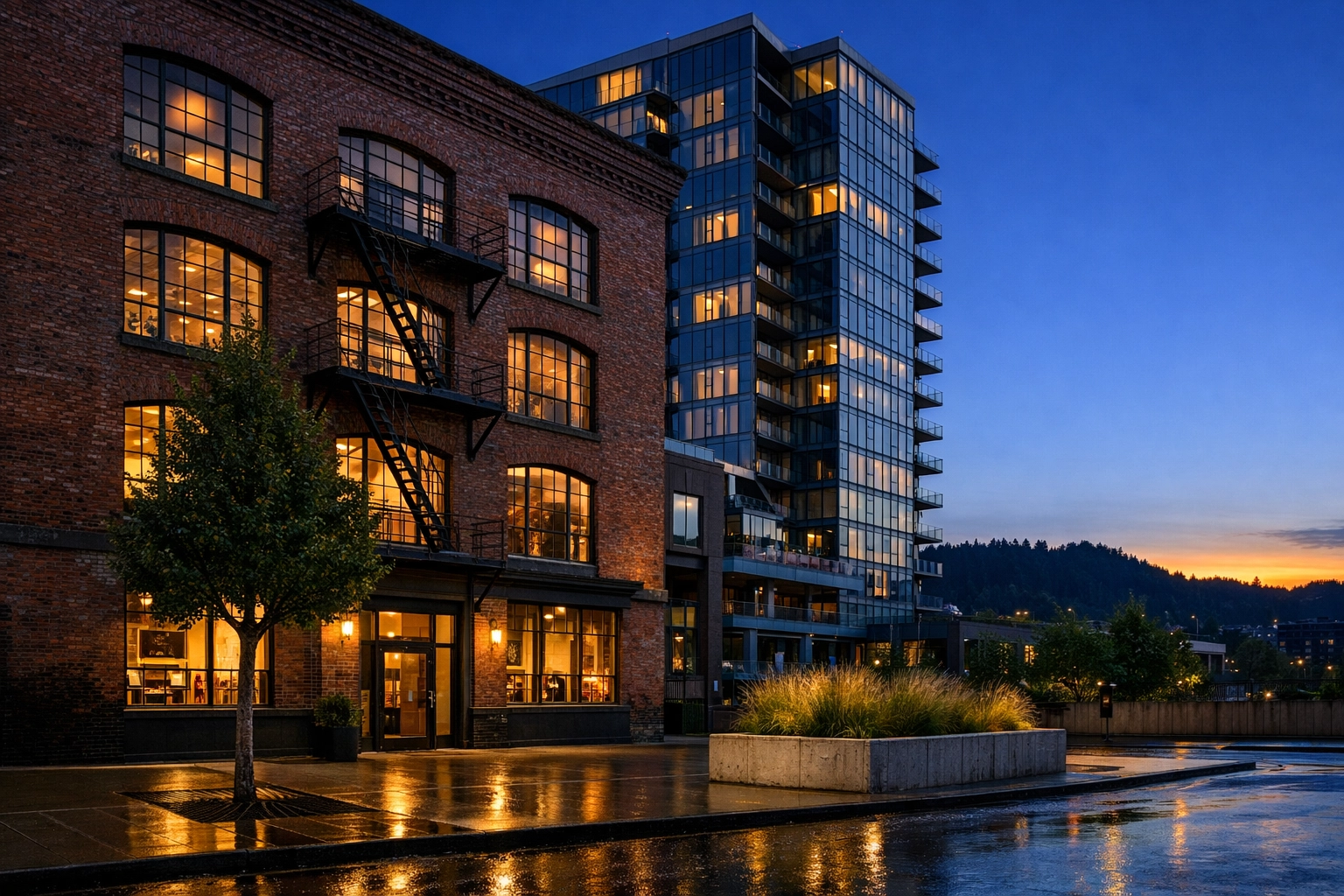
Northwest Portland is where the coffee shop has exposed brick and a chalkboard menu, the bookstore takes up an entire city block, and the trailhead is a 15-minute walk from your front door. The Pearl District fills the eastern edge with converted warehouse lofts, modern glass-and-steel condos, and one of the densest gallery and restaurant concentrations in the Pacific Northwest. On First Thursday Art Walk nights, the sidewalks on NW 13th are shoulder to shoulder. NW 23rd Avenue runs north through Nob Hill with boutiques, wine bars, and weekend brunch spots where the line wraps around the corner by 10 AM.
The western half of the district climbs into the hills toward Forest Park, 5,200 acres of urban forest with 80+ miles of trails accessible directly from neighborhood streets. You can leave a Pearl District condo, walk uphill past Craftsman duplexes, and within 15 minutes be deep enough in the forest canopy that the city disappears completely. That transition from polished urban streetscape to old-growth trail, happening over a few blocks, is what makes NW Portland unlike anywhere else in the metro. The Wildwood Trail connects to Washington Park, the Japanese Garden, and the Hoyt Arboretum without ever crossing a major road.
The housing stock here is overwhelmingly condos and townhomes. Single-family homes exist but they are scarce and priced at a premium. This is the district where a parking spot is worth $30K-$50K and a 900-square-foot condo with a Walk Score of 97 outsells a 2,000-square-foot house in the suburbs. If you want to leave your car parked all week and handle every errand on foot, NW Portland makes that possible. If you need a two-car garage and a fenced backyard, this is the wrong district.
Key Neighborhoods
- Pearl District - Converted lofts and modern condos, $450K-$1.2M. Walk Score 97. Powell's City of Books, ten galleries within four blocks, and the Jamison Square splash fountain.
- Nob Hill / NW District - NW 23rd and NW 21st retail corridors, $425K-$850K. Sidewalk dining, independent boutiques, and a neighborhood grocery store (New Seasons) at street level.
- Old Town - Active redevelopment zone, $300K-$500K. Saturday Market, Lan Su Chinese Garden, Voodoo Doughnut, and streetscape improvements changing the corridor year over year.
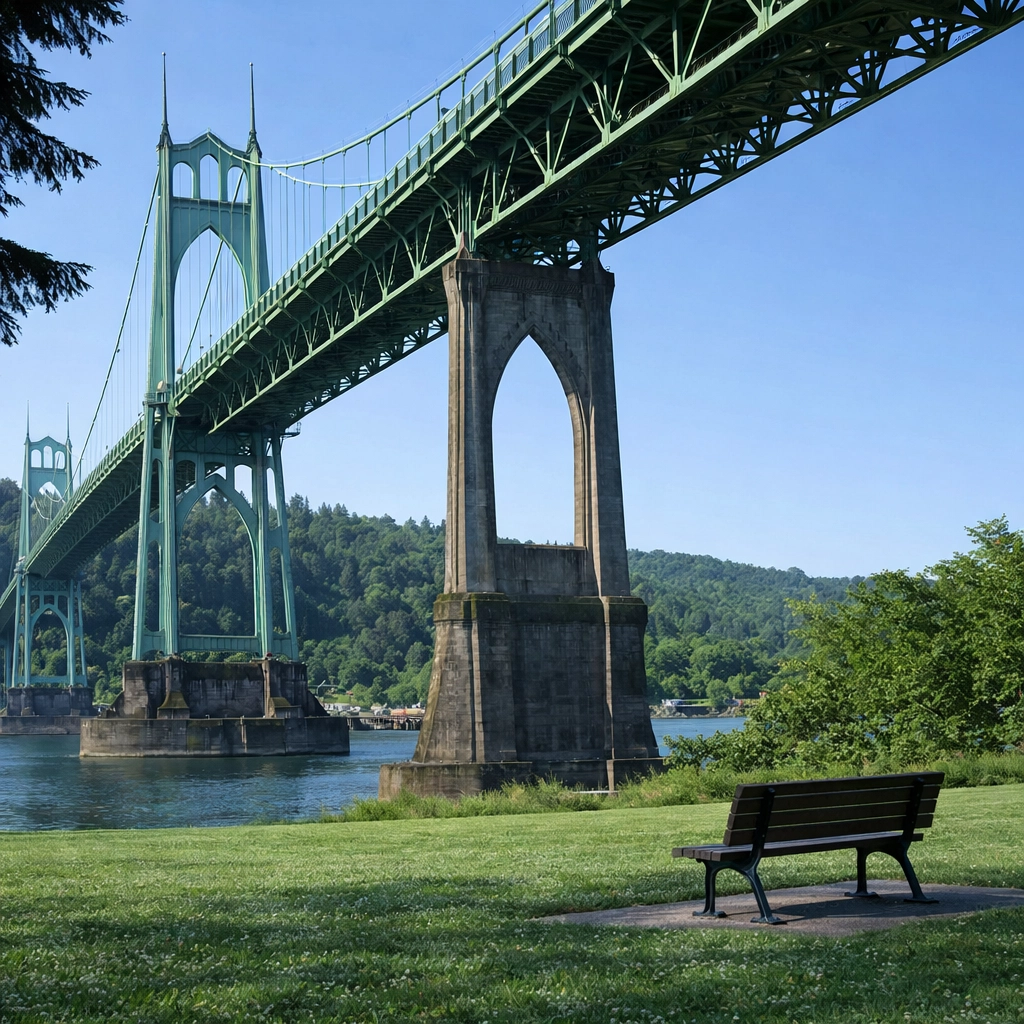
North Portland has the most distinct neighborhood identities of any district in the city, and it earns that distinction on architecture and commercial corridors rather than price. St. Johns sits at the northern tip beneath the gothic steel arches of the St. Johns Bridge, with its own downtown strip of restaurants, a weekend farmer's market, and Cathedral Park dropping down to the Willamette with stone columns and river access. The commercial block on N Lombard feels self-contained. There is a hardware store, a pizza shop, a bookstore, and a bar that has been there for decades, all within two blocks.
Kenton has the 31-foot Paul Bunyan statue on Interstate Avenue, a growing cluster of restaurants along Denver Avenue, and blocks of intact Craftsman bungalows with original millwork, covered front porches, and 5,000-square-foot lots. Mississippi Avenue, running through the Boise and Eliot neighborhoods, has become one of Portland's best restaurant and bar corridors. The block between Fremont and Shaver has a craft cocktail bar, a taco restaurant, a natural wine shop, and a bookstore within 200 feet of each other. Overlook has Willamette River views from the bluff above Swan Island, and Arbor Lodge has tree-lined streets and Peninsula Park with its formal rose garden and public pool.
The housing stock is predominantly 1920s-1940s Craftsman bungalows with some mid-century ranches and newer infill construction. Lot sizes typically run 4,000-6,000 square feet. This is the district where you can still buy a three-bedroom bungalow with a detached garage and a front porch for under $500K, which is increasingly rare inside Portland city limits. The trade-off is geographic: North Portland is the farthest district from the Sunset Corridor tech employers in Beaverton and Hillsboro.
Key Neighborhoods
- St. Johns - Self-contained commercial strip on N Lombard, $375K-$500K. Cathedral Park, the St. Johns Bridge, and a Saturday farmer's market on the town center plaza.
- Kenton - Denver Avenue restaurant row and intact bungalow blocks, $400K-$525K. Paul Bunyan statue, Interstate Avenue MAX Yellow Line access.
- Arbor Lodge - Tree-lined residential streets, $425K-$550K. Peninsula Park rose garden and pool, easy bike routes south to Mississippi and Williams.
- Overlook - Bluff-top views of the Willamette and Swan Island, $450K-$575K. Interstate Avenue MAX access and a 10-15 minute drive to downtown, traffic depending.
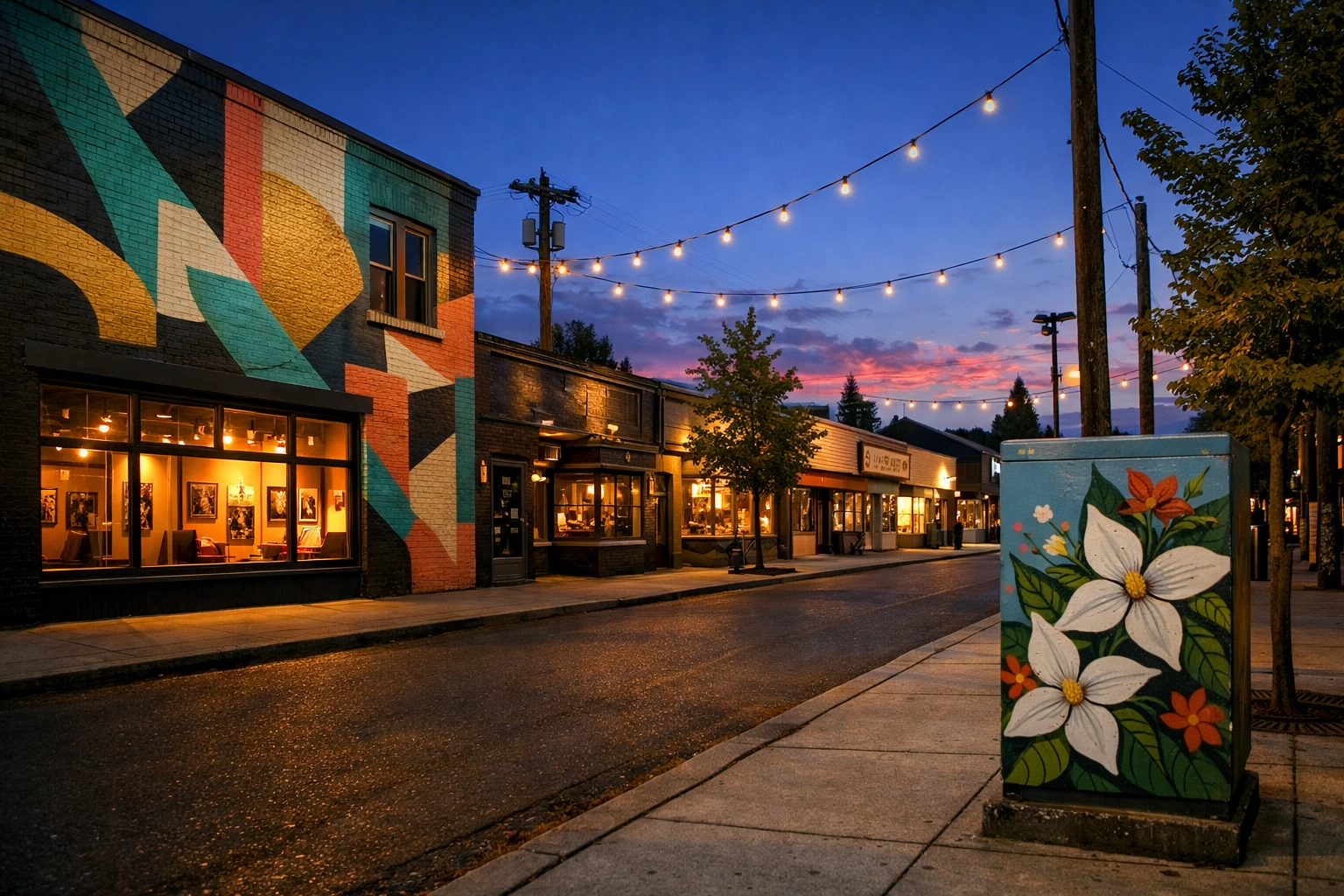
Northeast Portland is where the city's built environment tells the most layered story. Alberta Street has galleries showing new work in the windows, murals covering entire building facades, and a Last Thursday art walk that shuts down the corridor to traffic and fills it with street performers and pop-up vendors. On a regular Wednesday night, the restaurant density on Alberta between 15th and 30th rivals any food street in the Pacific Northwest. Irvington has the strictest historic preservation overlay in the city, which means blocks of early 1900s Victorians and Foursquares with original leaded glass, wraparound porches, and mature elm canopy that arches over the street.
Beaumont-Wilshire and Alameda sit further east with wider lots, older street trees, and walkable commercial strips on Fremont and Beaumont. The commercial strip on NE Fremont between 40th and 50th has an independent bookstore, a cheese shop, an ice cream parlor, and a neighborhood pizza place all within three blocks. Rose City Park and Roseway extend the grid with 1940s-1950s ranches and bungalows at price points $100K-$200K below equivalent Irvington or Alameda homes, while still keeping you within a 10-minute bike ride of the Alberta and Hollywood corridors.
The price range in NE Portland is the widest of any district, from mid-$400s in outer Roseway to over $1M in Alameda and Irvington. The housing stock spans every era: Victorian mansions, Craftsman bungalows, mid-century ranches, and modern infill. Lot sizes in inner NE run 4,000-5,000 square feet, while outer NE opens up to 6,000-7,000. The Tillamook Street bike greenway runs east-west through the heart of the district, and the Hollywood MAX station connects to downtown in 12 minutes.
Key Neighborhoods
- Irvington - Historic preservation overlay with Victorians and Foursquares, $650K-$1M. Leaded glass, wraparound porches, and elm-canopy streets.
- Alberta / Concordia - Gallery district with mural-covered facades, $450K-$650K. Last Thursday art walk, restaurant density from 15th to 30th, and protected bike lanes.
- Beaumont-Wilshire - Walkable Fremont Street commercial strip, $550K-$750K. Independent shops, established street trees, and proximity to Grant High School (Niche B+).
- Rose City Park - 1940s-1950s bungalows and ranches, $475K-$625K. Close to Hollywood MAX and I-84 access. Strong value for the location.
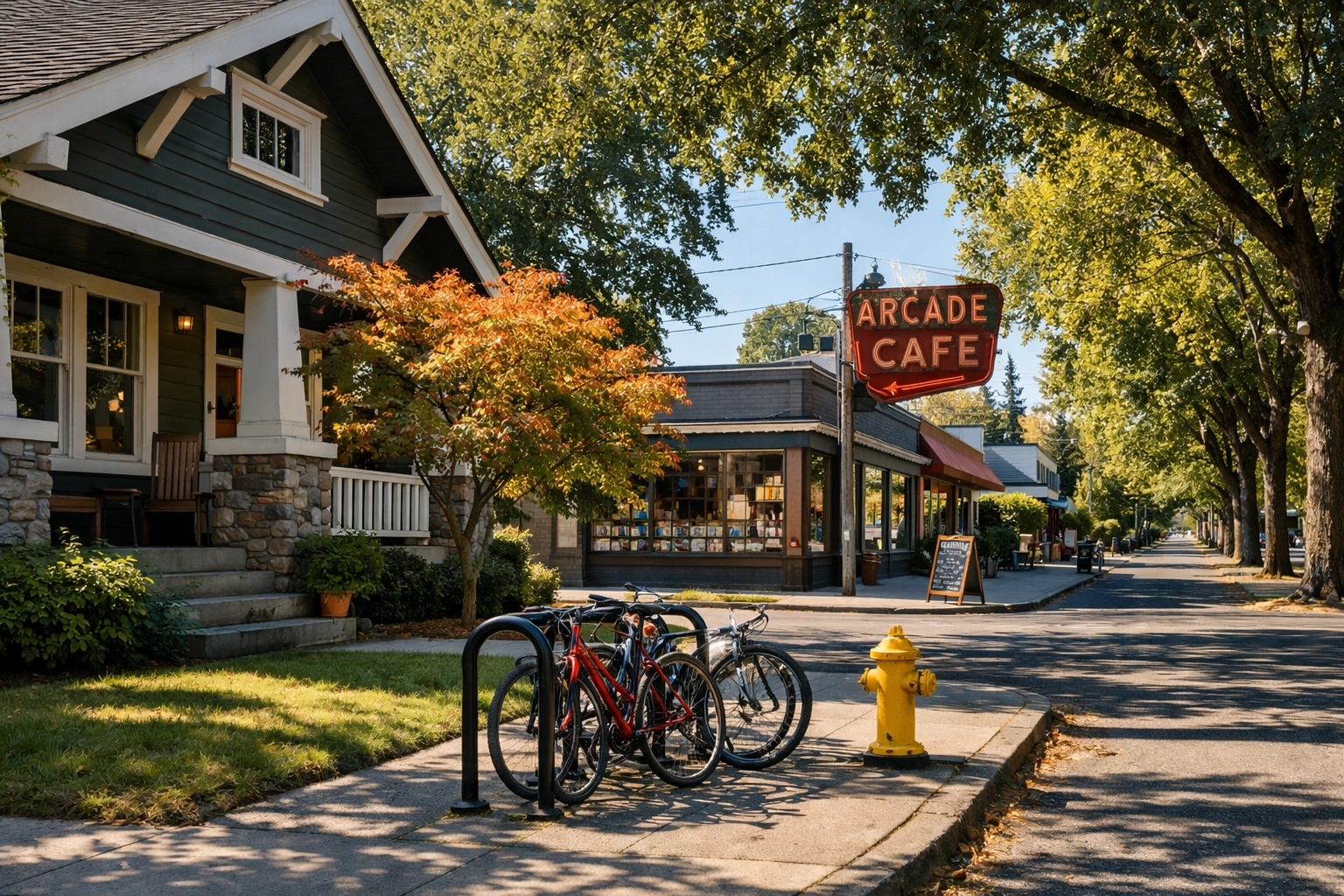
Southeast Portland is where the independent-business density is highest and the commercial corridors have the most character per block of any district in the city. Hawthorne Boulevard has vintage shops with hand-painted signs, bookstores that have been open since the 1980s, and restaurants that change the menu weekly based on what came in from the farm that morning, all sitting next to the places that opened last month. Division Street went from a quiet residential connector to a nationally recognized dining corridor in a decade. The block between 30th and 39th has James Beard-nominated restaurants sitting alongside Thai food carts, a natural wine bar, and a coffee roaster that sources single-origin beans from three continents.
Mt. Tabor Park sits on a volcanic cinder cone in the middle of the district with open reservoirs, forested trails through Douglas fir, and a summit that gives you a panoramic sweep from Mt. Hood to downtown. The park is the kind of place where you run into the same people every Tuesday morning because the loop trail becomes part of your routine. Sellwood-Moreland anchors the southern edge with a walkable stretch of SE 13th (antique shops, a movie theater, restaurants, and Oaks Bottom Wildlife Refuge two blocks away). Foster-Powell and Woodstock are where updated 1920s bungalows and newer construction sit at prices that were unthinkable for inner Portland five years ago.
The housing stock in inner SE is a mix of Craftsman bungalows, Old Portland homes, and modern infill townhomes. Lot sizes are tight (3,500-5,000 square feet is standard) and street parking is the norm. The Springwater Corridor trail runs through the southern edge connecting to the Eastbank Esplanade and downtown without riding in traffic. The Clinton Street bike greenway crosses east-west. Walk Scores in inner SE typically range from 80-92. If you want to handle your daily life on foot or by bike, SE Portland is built for that. If you need 2,500 square feet and a three-car garage, the inventory does not exist here.
Key Neighborhoods
- Hawthorne / Division - Two nationally recognized food corridors within a mile, $475K-$750K. Walk Scores 85-92, dense independent retail, and Ladd's Addition nearby.
- Sellwood-Moreland - SE 13th antique row and Oaks Bottom wildlife access, $500K-$700K. Walkable commercial strip with a small-town streetscape inside the city.
- Woodstock - Growing commercial strip on Woodstock Blvd, $425K-$575K. New restaurants, a taproom, and bungalows with covered front porches.
- Foster-Powell - Best value in inner SE, $400K-$525K. Foster Road commercial redevelopment, new breweries, and the highest appreciation rate in the district.
Narrowing It Down?
Tell me your top two districts and I will send you the five best listings this week. No obligation.
Responds within 24 hours · (503) 910-7364
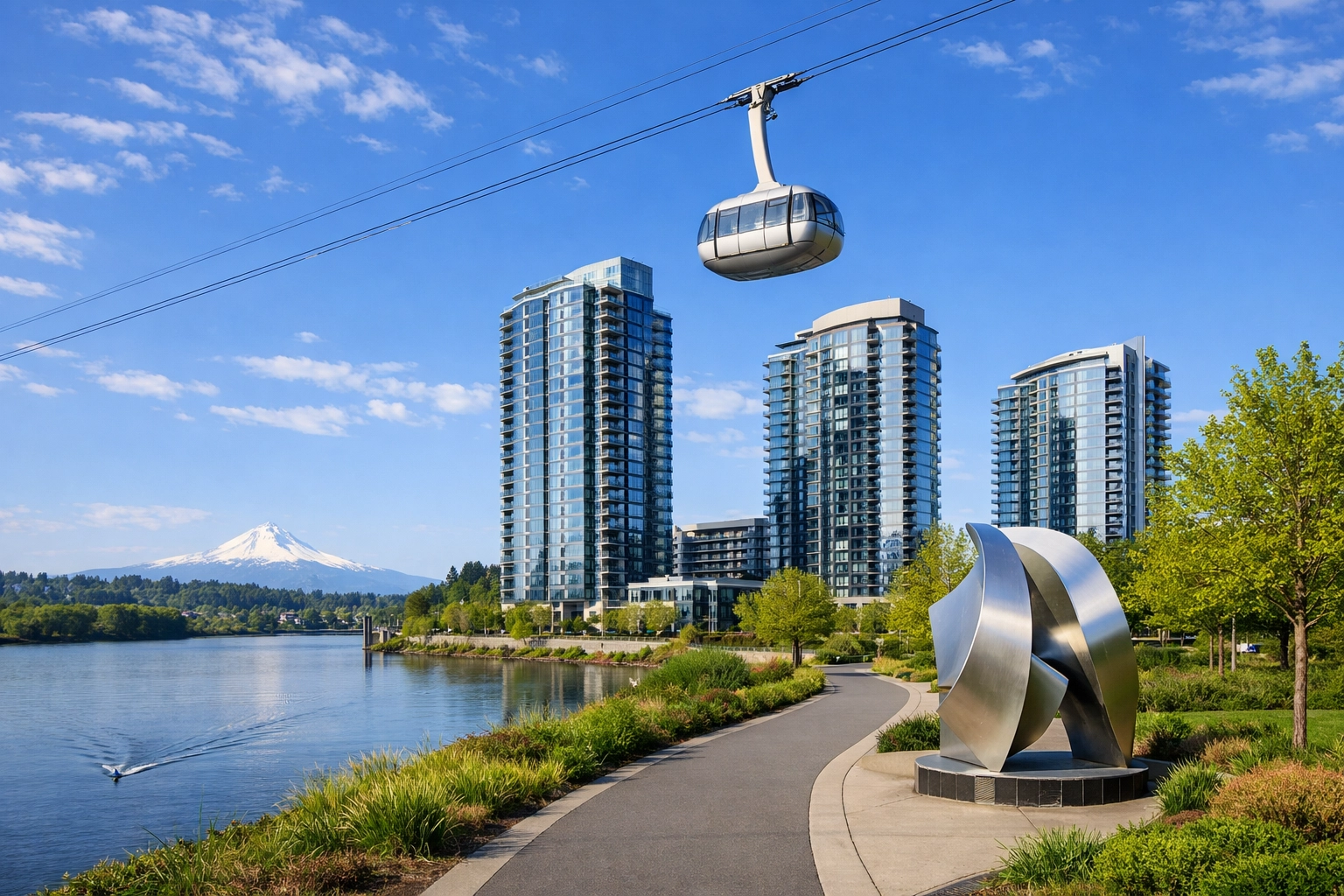
South Portland is a single official neighborhood stretching as a narrow strip between the Willamette River and the West Hills, from the Marquam Bridge south to the Sellwood Bridge. It was formerly known as Corbett-Terwilliger-Lair Hill and includes several distinct sub-areas: the modern glass condo towers along the waterfront with the OHSU aerial tram overhead, the historic Victorian-era homes of Lair Hill, the Corbett Avenue corridor with restaurants and local businesses, the Terwilliger hillside with scenic viewpoints, and the Johns Landing stretch along Macadam Avenue with its mix of bungalows, townhomes, and riverfront condos.
The northern waterfront edge has the newest housing stock in Portland. Most units were built after 2005 with floor-to-ceiling windows, in-unit laundry, and rooftop terraces. Moving south, the architecture shifts to some of the oldest residential buildings in the city. The Willamette River greenway runs the full length of the district, connecting north to the Eastbank Esplanade. The Macadam Avenue strip has restaurants and a Zupan's market, but daily shopping options are limited compared to adjacent districts.
The price range spans $350K for a one-bedroom waterfront condo to $750K+ for a larger home in the Terwilliger or Johns Landing areas. The trade-off is commercial infrastructure. Most daily errands typically require a short drive to adjacent SE or SW corridors.
Key Neighborhoods
- South Portland - One official neighborhood covering Lair Hill, Corbett, Terwilliger, Johns Landing, and the waterfront condo towers. Victorian homes, Macadam Avenue dining, OHSU tram access, and Willamette River greenway. $350K-$750K.
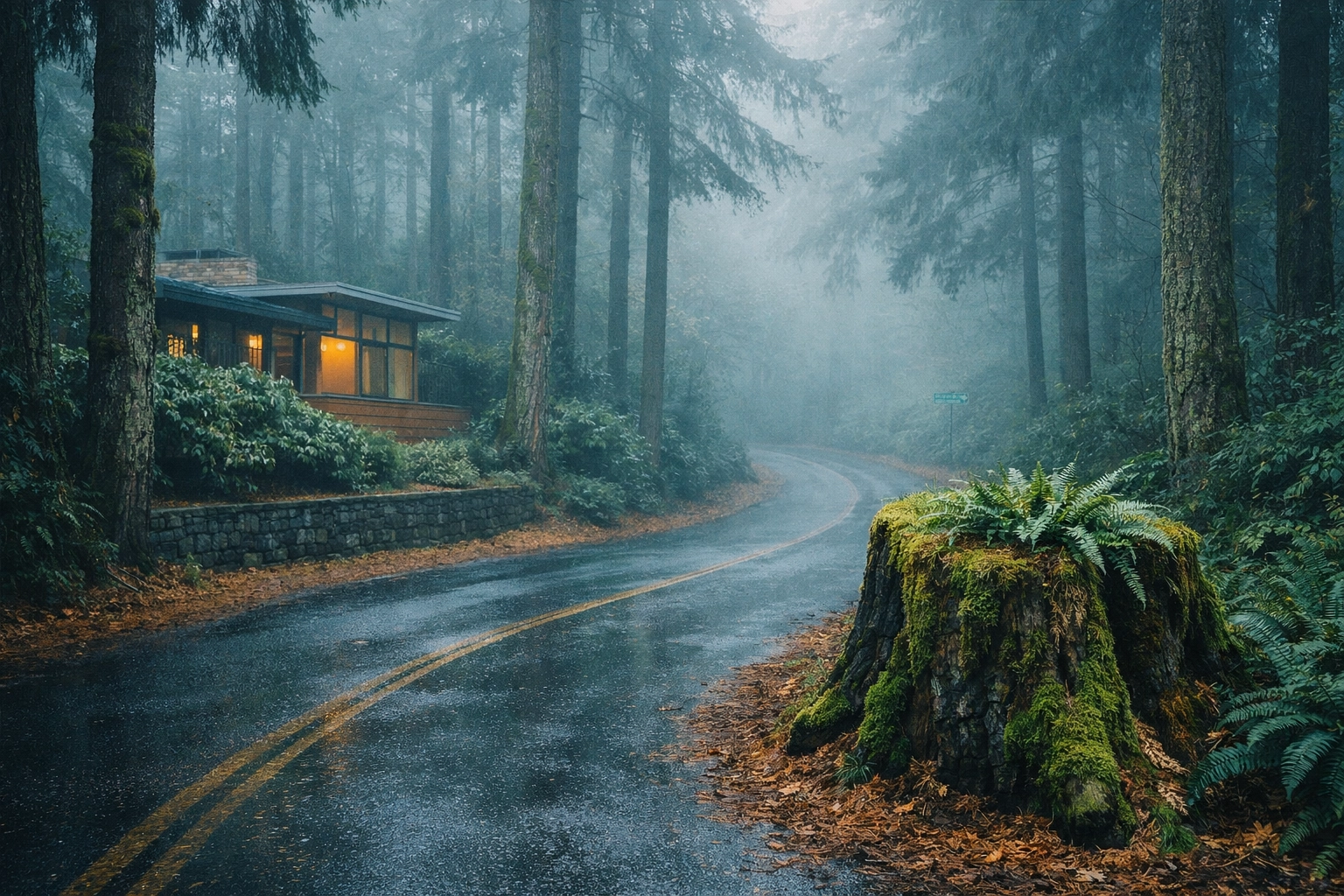
Southwest Portland is where the city gets quiet. The streets wind through hills. The canopy closes over the road. Douglas firs line the property edges and your nearest neighbor's roofline disappears behind the trees. Multnomah Village has Annie Bloom's Books (one of Portland's last great independent bookstores), a Saturday farmer's market on the plaza, a brewpub, and a cluster of restaurants that give the commercial block a small-town main street identity. The walk from Annie Bloom's to the Multnomah Arts Center takes two minutes. The vibe is town square, not city grid.
Hillsdale has its own walkable village core anchored by Baker and Spice, Hillsdale Brewery, and a natural grocery store. The walk from Hillsdale to Multnomah Village along Capitol Highway takes about 20 minutes on a sidewalk that passes through a residential stretch of 1950s ranches and split-levels. The West Hills (Portland Heights, Council Crest, SW Hills) have the largest residential lots in the city, many exceeding a quarter-acre, with sweeping views of Mt. Hood, Mt. St. Helens, and the downtown skyline from elevation. These are premium-priced properties where $700K is the entry point and $1M+ is standard for a view lot with a mature canopy.
The housing stock ranges from 1920s Tudors in Multnomah Village to 1960s-1970s ranches in Maplewood to custom-built hillside homes in the West Hills. Lot sizes are the largest in Portland: quarter-acre to full-acre is common. The trade-off is real and it is not subtle. Most of this district has Walk Scores under 40. There are no sidewalks on many residential streets in the hills. The nearest MAX station is Goose Hollow at the district's northeast edge, but reaching it requires driving from most SW neighborhoods. A two-car household is the functional default. If you want a property that feels like a retreat from the city while remaining inside city limits, SW Portland delivers. If you want to walk out your front door to a restaurant, this is the wrong district.
Key Neighborhoods
- Portland Downtown - Urban core with high-rise condos and MAX access, $350K-$800K. Pioneer Courthouse Square, the South Park Blocks, and walkable access to every major cultural venue in the city.
- Goose Hollow - Close-in with MAX Blue Line access, $350K-$600K. Providence Park (Portland Timbers and Thorns), and strong value relative to the Pearl.
- Arlington Heights / Sylvan-Highlands - West Hills location near Washington Park, $600K-$1.2M. Oregon Zoo, Japanese Garden, and Hoyt Arboretum all within walking distance.
- SW Hills / Portland Heights - Custom hillside homes with views, $700K-$2M+. Quarter-acre to full-acre lots, Douglas fir canopy, and Council Crest Park summit.
- Multnomah Village - Small-town main street inside the city, $500K-$700K. Annie Bloom's Books, farmer's market, and the closest thing SW Portland has to a walkable downtown.
- Hillsdale - Village core with bakery, brewery, and grocery, $475K-$650K. Wilson High School (Niche B+) nearby, Rieke Elementary within walking distance.
- Maplewood / Arnold Creek - Large lots on quiet streets, $525K-$750K. Tryon Creek State Natural Area for trail running and hiking, eight miles of trails.
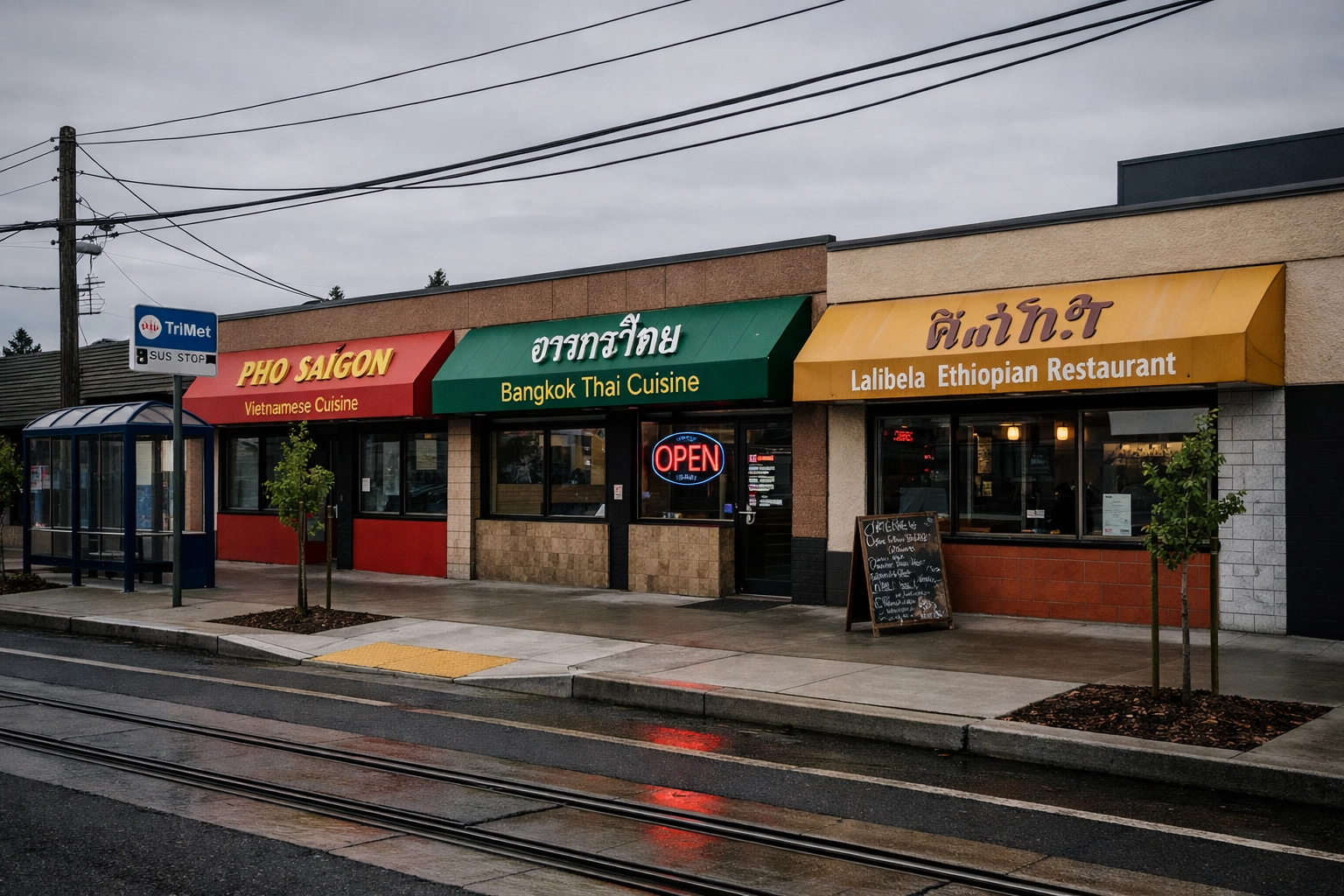
East Portland is where your dollar goes the farthest and the food corridor on 82nd Avenue is one of the most underrated in the state. The Jade District investment and the 82nd Avenue of Roses project are reshaping the commercial strip with new sidewalks, street trees, and infrastructure improvements. The restaurants along 82nd represent cuisines from Vietnamese pho houses and Thai curry spots to Ethiopian injera platters and Salvadoran pupuserias. These are not food-trend restaurants. They are places with handwritten menus, family recipes, and prices that make inner Portland dining feel like a splurge by comparison.
Gateway is the MAX transit hub where the Blue, Green, and Red lines converge at a single station complex, giving you direct rail access to downtown Portland, PDX airport, and the Hillsboro tech corridor without a car. The Gateway Transit Center is the only point in Portland where three MAX lines intersect. Montavilla (centered on SE Stark Street near 76th) is the emerging commercial strip in this district, with new restaurants, the historic Academy Theater (second-run films, pizza, and beer), and bungalow-era housing stock priced $100K-$150K below equivalent inner east-side homes. Lents has the Lents Town Center redevelopment, the Springwater Corridor trail running through the neighborhood, and new commercial development along SE Foster and SE 92nd.
The housing stock in East Portland is newer than most of the city. Post-1970 construction is common, and many homes built after 2000 have attached garages, 1,500-2,000 square feet, and lots that are larger than inner Portland's standard 5,000-square-foot parcels. A three-bedroom, two-bath home with a garage and a yard is available here for $375K-$450K, a price point that effectively does not exist west of 60th Avenue. The trade-off is walkability. Most of this district has Walk Scores in the 30s-50s. Commercial corridors are spaced farther apart. Sidewalk coverage is incomplete on some residential streets. The infrastructure investment is real and visible, but it is not complete.
Key Neighborhoods
- Gateway / Russell - Three-line MAX transit hub, $325K-$425K. Direct rail to downtown (15 min), airport (25 min), and Hillsboro (45 min). The strongest transit access in outer Portland.
- Montavilla - Emerging SE Stark commercial strip, $400K-$500K. Academy Theater, new restaurants, and bungalows with covered porches and detached garages.
- Lents - Springwater Corridor trail access, $350K-$450K. Lents Town Center, new commercial development, and 20-minute MAX ride to downtown.
- Hazelwood - Post-2000 construction with garages, $325K-$400K. Near Gateway MAX, I-84 access, and 82nd Avenue food corridor.
Answers based on current market data and 10+ years of helping buyers relocate to the Portland metro area.
Researching Portland but not ready to talk yet? Save this guide and come back when you are.
✉ Email Me This GuideNo spam. Just the guide link and a quick intro from Joe.

Portland rewards people who pick a neighborhood, not just a city. The buyer who says 'I want to live in Portland' and the buyer who says 'I want to be on Alberta Street within biking distance of my office on MLK' are having two completely different real estate experiences. My job is to get you from the first statement to the second one.
What I notice showing homes across Portland's seven districts that the data does not capture is how sharply the character changes block by block. The shift from the Victorian row houses in Irvington to the mid-century ranches in Rose City Park happens over two streets. The walk from Division Street's new-build apartment towers to Ladd's Addition's 1905 colonial revival homes is 10 minutes. No data set captures that, and no online listing tells you what it feels like to stand at the corner of NE Alberta and 30th on a Thursday evening.
Portland works best for buyers who have done the neighborhood research before they start looking at houses. The buyer who knows they want to be east of 50th but west of 82nd, or north of Fremont but south of Killingsworth, is the buyer who ends up happy. The buyer who says "I want Portland" and starts looking at every listing in the MLS is the buyer who gets overwhelmed. That is why this guide exists, and that is why the map above breaks the city into seven districts with 74 labeled neighborhoods. Start there.
The development pipeline in Portland is concentrated on the inner east side (Division, Foster, Williams corridors) and in the Pearl District. Downtown is in a post-pandemic recovery phase that is slower but measurable, with commercial lease activity increasing in 2025-2026. The outer east side is seeing infrastructure investment from the Powell-Division Transit and Community Project. I expect the city's neighborhood price stratification to continue, with inner walkable neighborhoods appreciating faster than outer car-dependent areas.
Joe Saling · Saling Homes at eXp Realty · 10+ years in Portland metro real estate
Each suburb has its own full relocation guide with neighborhoods, schools, dining, commute data, and current listings.
Portland Might Not Be Right For You If...
Live MLS data updated daily. Click any listing row to see full details on sellingpdxhomes.com.
| Address | Date | Type | Beds · Baths · SqFt | Price | |
|---|---|---|---|---|---|
| Loading live data... | |||||
As a first time home buyer, I had no clue what I was doing and felt lost once I located an area I wanted to buy in. I stumbled on Joe's website by accident, thinking I was on a different realtor's listing. I am SO glad I did! Joe made the entire process so smooth! Buying a home is a LOT but he explained every step thoroughly and advised me on the pros and cons of each situation. His support and guidance enabled me to make any needed decisions with confidence. I am thrilled with my new home! I honestly could not have found and purchased it without him!Read More Client Reviews
Discovery Call
You tell me your budget, timeline, must-haves, and lifestyle priorities. I ask the questions you have not thought of yet.
Neighborhood Tour
We visit 3-5 neighborhoods in person so you can feel the difference between Alberta Street energy and Sellwood-Moreland quiet.
Home Search
Targeted listings, off-market opportunities, and honest assessments. I tell you what is wrong with a house before you ask.
Close and Move In
Negotiation, inspection, and closing managed start to finish. You focus on packing. I handle the details.
Let's Find Your Portland
No obligation, no pressure. Just straight answers and local expertise from someone who knows every corridor of this city.
Schedule a Free ConsultationResponds within 24 hours · (503) 910-7364