

OR Portland
Centennial





Living in Centennial
A large East Portland neighborhood on the Gresham border with 1960s ranches, the 25-acre Parklane Park, Powell Butte Nature Park access, and its own Centennial School District.
Updated April 2026 by Joe SalingWhat Centennial Is Really Like
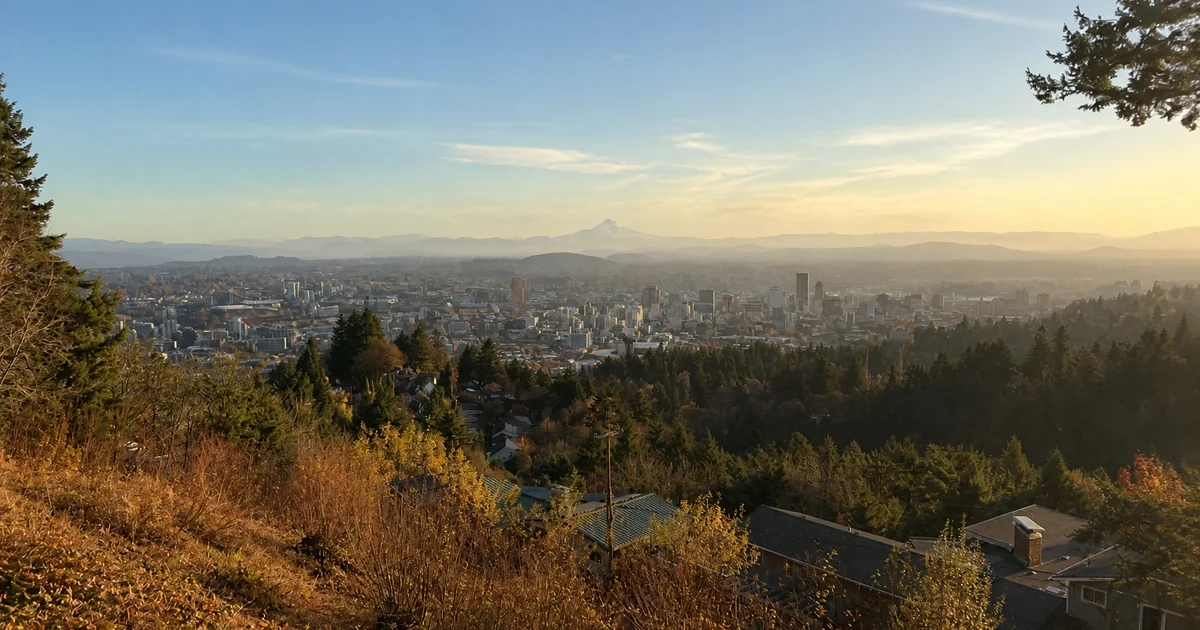
Centennial is one of the largest geographic neighborhoods in East Portland, running roughly from SE Division Street on the south to SE Stark Street on the north, and from around SE 122nd or 148th Avenue on the west out to the Gresham city line on the east. It is bordered by Hazelwood, Glenfair, Pleasant Valley, and Powellhurst-Gilbert, and Powell Butte Nature Park sits on the southern edge. The defining geography is the Powell Butte cinder cone to the south and the gently rolling terrain that slopes down toward the Johnson Creek watershed, with Mount Hood visible from many blocks. The neighborhood has its own Centennial School District, which is unusual for a Portland neighborhood and is one of the first things buyers notice.
A weekday morning in Centennial feels suburban rather than urban: cars pulling out of driveways, buses running along SE Division, Powell, and Stark, and the steady hum of the MAX Blue Line running along Burnside just north of the neighborhood. The commercial life happens on the arterials. SE 122nd, Division, Powell, and Stark carry a mix of local restaurants, chain retail, grocery stores (Safeway, WinCo, Fubonn Shopping Center just west in Hazelwood), and international markets reflecting the neighborhood's diverse business landscape. Weekends shift toward Powell Butte, the expanded 25-acre Parklane Park, and Verdell Burdine Rutherford Park with its renovated playground and community garden.
On residential blocks you will see gardeners working yards, walkers heading to the parks, and bike commuters on the newer neighborhood greenway sections. The Centennial Community Association runs volunteer events at Parklane Park and partners with Portland Parks & Recreation and The Nature Conservancy on native planting projects at Powell Butte. Most residential streets have sidewalks, though their condition varies block by block as this is a post-annexation neighborhood that was built out before Portland standards applied. Residents rely heavily on cars for errands, with I-205 about 10 minutes west for north-south freeway access.
Looking for broader context on the area? Read my full East Portland relocation guide for how Centennial fits into the wider district.
Homes and Architecture in Centennial
Centennial's housing stock was shaped primarily by the post-WWII and 1960s-70s suburban build-out. The largest share is boxy single-level ranches and split-level homes from the 1950s, 60s, and 70s, sitting on lots that generally run larger than inner Portland. A secondary layer of 1980s and 1990s two-story traditional homes fills in the eastern pockets closer to the Gresham line, and scattered 21st-century New Traditional infill homes appear on larger redeveloped parcels. Lot sizes commonly run 7,000 to 10,000 square feet, with some larger acreage parcels on the southern edge closer to Powell Butte.
When you shop here, expect a wide range of condition. Some homes have been carefully updated by long-term owners; others retain original kitchens, baths, and systems from the 1960s and 70s. The pricing is genuinely entry-level for Portland, which is part of the appeal, but it also means that cosmetic updates do not always translate into bidding wars and competitive dynamics are less intense than inner Portland. Two specific items worth pricing into your underwriting: sidewalk condition and curb ramps (uneven in many pockets), and original cast-iron or concrete sewer laterals that commonly show wear at 50 to 70 years old. The southern edge near Johnson Creek has some properties inside or near the FEMA floodplain, which warrants a map check.
- 1960s-70s ranch & split-level
- 1980s-90s two-story traditional
- New Traditional infill
- 7,000 to 10,000 sq ft lots common
- Entry point for Portland
Geography, Amenities, and Getting Around
Powell Butte & Johnson Creek Watershed
Powell Butte Nature Park on the southern edge is a 611-acre extinct cinder cone with panoramic views of Mount Hood from the summit, a network of hiking and mountain biking trails, and meadow habitat that draws birders year-round. The Johnson Creek watershed runs along the southern boundary and into Pleasant Valley, giving the south half of Centennial a greener, creek-influenced feel than the arterial-dominated north half.
SE 122nd & Division Corridors
Closest full-service groceries include Safeway and WinCo on SE Division, with Fubonn Shopping Center (the largest Asian supermarket in Oregon) a few minutes west on SE 82nd. Chain retail clusters at SE 122nd and Division, SE 162nd and Stark, and along Powell. Dining includes a strong Vietnamese, Mexican, and Ethiopian presence along the 122nd and Powell corridors. Downtown Gresham is 10 minutes east for additional grocery, hardware, and dining.
Parklane Park & Powell Butte
Parklane Park expanded from 5 to 25 acres in recent years, now including a community garden, skate park, off-leash dog area, and renovated sports fields. Verdell Burdine Rutherford Park has a new playground, picnic shelter, paved pathways, and renovated soccer field. Powell Butte Nature Park (611 acres) is the headline outdoor amenity, accessible on foot from the southern blocks. Lynchwood Park rounds out the in-neighborhood options.
Getting Around
The MAX Blue Line runs along E Burnside just north of the neighborhood, with stations at E 148th, E 162nd, E 172nd, and E 181st. TriMet bus lines 20 (Burnside), 4 (Division), 9 (Powell), 71 (122nd), and 87 (Airport Way) cover the arterial grid. I-205 is roughly 10 minutes west; downtown Portland runs about 25 to 35 minutes by car off-peak and 45 minutes or more by MAX. Downtown Gresham is 10 minutes east.
Joe's Take on Centennial
When buyers tell me they want a single-family home in Portland at the lowest entry point, on a lot that is bigger than inner Portland gives you, Centennial is usually on the short list. You typically pay meaningfully less per square foot here than anywhere in inner Portland, you get larger lots, and you get genuine outdoor access through Powell Butte and the expanded Parklane Park. The honest trade-off is commute and walkability. The commercial life happens on wide arterials like 122nd, Division, Powell, and Stark, all of which are built for cars rather than pedestrians, and the commute to downtown Portland is meaningfully longer than from inner East Portland neighborhoods.
The housing stock and location suit buyers who want more home and lot for the money, who do not need a daily downtown commute, and who value access to Powell Butte for hiking or to the MAX Blue Line for occasional trips in. It works well for remote workers, for buyers who work in Gresham or East Portland, and for anyone who prioritizes the Centennial School District as a specific draw. It is less of a fit for buyers who want to walk to a commercial corridor, who have a daily downtown commute, or who want the density of inner Portland.
Before you write an offer in Centennial, there are a few specifics worth checking. Verify the school district assignment, since parts of the neighborhood are in Centennial SD, some in Portland Public Schools, and a sliver on the east edge in Gresham-Barlow SD; boundaries matter. Pull the FEMA flood map for any property near the southern edge along the Johnson Creek watershed. Walk the block to check sidewalk condition, since post-annexation areas often have incomplete sidewalk networks. Order a sewer scope on any pre-1980 home, since cast-iron and concrete laterals at this age commonly show problems. Finally, check the ODOT freight route and TriMet bus frequency for your specific address, since traffic noise and bus proximity vary significantly block to block.
Frequently Asked Questions About Centennial
How do home prices in Centennial compare to the rest of East Portland?
Centennial consistently prices at the lower end of the Portland market and is one of the most affordable neighborhoods inside the city limits. The outer location, the distance from downtown, and the post-annexation housing stock all contribute to the entry-level price point. Expect to pay less per square foot than Argay Terrace, Parkrose, or Russell to the north, roughly in line with Powellhurst-Gilbert and Pleasant Valley to the south, and above some Gresham neighborhoods directly east of the city line. Homes backing Powell Butte or on larger south-edge lots sit at the upper end of the Centennial range. The current average sales price and active listing count are shown at the top of this page and update automatically with the market.
What are property taxes like in Centennial?
Multnomah County property taxes in Centennial run at an effective combined rate of approximately 1.3% to 2.1% of assessed value. Because Centennial home values tend to be lower than most Portland neighborhoods, typical annual property tax bills are also lower on average. The actual rate depends on school district assignment (Centennial SD, Portland Public, or Gresham-Barlow depending on the address). Oregon Measure 50 caps assessed value growth at 3% per year, so long-held homes often pay less than market value would suggest. Verify current rates and the specific assessment for any address at multco.us/assessment-taxation.
Which schools serve Centennial?
Most of Centennial is served by the Centennial School District, which is one of the few Portland-city neighborhoods with its own independent district. Default assignments typically include Parklane, Lynch Meadows, or Oliver Elementary, Centennial Middle School, and Centennial High School. A portion of the northwestern section falls in Portland Public Schools (serving David Douglas or Madison High School depending on the specific line), and a sliver on the east edge borders Gresham-Barlow School District. Boundaries matter here because the three districts rate differently. Verify the specific address assignment at csd28j.org for Centennial SD or at pps.net for PPS.
What is the housing stock like in Centennial?
Housing stock is predominantly 1960s and 1970s ranches and split-level homes on 7,000 to 10,000 square foot lots, with a secondary layer of 1980s and 1990s two-story traditional homes in the eastern pockets and scattered New Traditional infill on redeveloped parcels. Larger acreage lots appear on the southern edge near Powell Butte and Johnson Creek. Most homes have some combination of original features and updated systems. Amenity access includes Powell Butte Nature Park (611 acres) to the south, the expanded 25-acre Parklane Park, Verdell Burdine Rutherford Park, and Lynchwood Park. The MAX Blue Line runs along the neighborhood's northern edge.
How long is the commute from Centennial to downtown Portland?
Downtown Portland is typically 25 to 35 minutes by car outside of peak hours, using Powell, Division, or I-205 to I-84. Peak-hour drives commonly push past 40 minutes, and freeway incidents can extend that significantly. The MAX Blue Line offers an alternative from stations along E Burnside at 148th, 162nd, 172nd, or 181st, with total downtown travel time of roughly 45 to 55 minutes including walk to the station. Downtown Gresham is closer at about 10 minutes by car, and many Centennial residents work locally or in East Portland rather than downtown.
Is Centennial walkable?
Centennial is not a walkable neighborhood in the inner-Portland sense. Commercial amenities are concentrated along wide arterials (122nd, Division, Powell, Stark) that are built for cars, and daily errands typically require driving. Walk Scores in the neighborhood generally run in the 30s to 50s. The strongest walking infrastructure is Parklane Park, Verdell Burdine Rutherford Park, and the trail network at Powell Butte Nature Park on the southern edge. Sidewalk coverage on residential streets is uneven block by block, reflecting the neighborhood's post-annexation history, and something to verify for any specific address.
How does Centennial compare to nearby East Portland neighborhoods?
Centennial typically prices similarly to Powellhurst-Gilbert and Pleasant Valley, below Hazelwood to the west and Argay Terrace to the north, and above some directly adjacent Gresham neighborhoods. Compared to Powellhurst-Gilbert, Centennial offers better access to Powell Butte and the Centennial School District; Powellhurst-Gilbert has more 1920s-era housing variety in its older pockets. Compared to Pleasant Valley directly south, Centennial is more arterial-oriented; Pleasant Valley has more acreage and rural-edge character. Hazelwood to the west has better transit access on I-205 and more commercial density. Centennial is the pick when a buyer wants the Centennial School District, direct Powell Butte access, or the largest-lot-for-the-price trade-off.
Can I add an ADU or short-term rental in Centennial?
Most Centennial single-family lots are eligible for an accessory dwelling unit under Portland's Residential Infill Project rules, which allow up to one ADU on a single-family lot. The larger lot sizes here often make ADU construction more flexible than in denser inner Portland neighborhoods. Short-term rentals require a City of Portland STR permit; Type A permits require owner-occupancy, and Type B permits (non-owner-occupied) have stricter limits and are harder to obtain. Verify both ADU eligibility and STR permit type for your specific address with Portland Bureau of Development Services (portland.gov/bds) before counting on rental income. The sliver of Centennial on the Gresham side follows Gresham permitting rules, not Portland's.
Thinking About Buying in Centennial?
I help buyers navigate East Portland neighborhoods every week. Let's talk about what you need, what you can afford, and whether Centennial is the right fit.
Schedule a Free Consultation Or call Joe directly: (503) 910-7364Joe Saling · Saling Homes at eXp Realty · 10+ years serving Portland metro buyers and sellers
Saling Homes at eXp Realty is committed to the principles of the Fair Housing Act and Equal Housing Opportunity. Licensed in the State of Oregon. Information deemed reliable but not guaranteed. Verify all data independently before making real estate decisions.
MY BLOGS

MARKET TRENDS

HOUSING DETAIL
NEARBY SCHOOL & BUSINESS
3133 SE 152ND AVE, Portland, OR 97236
Single Family Home 3 Beds 2 Baths 1,536 SqFt
Listed by Think Real Estate
14556 SE BUSH ST, Portland, OR 97236
Single Family Home 3 Beds 2 Baths 1,818 SqFt
Listed by Premiere Property Group, LLC4849 SE ANDEREGG LOOP, Portland, OR 97236
Single Family Home 4 Beds 2.1 Baths 2,435 SqFt
Listed by Works Real Estate673 SE 148TH AVE #11, Portland, OR 97233
Townhouse 3 Beds 2.1 Baths 1,372 SqFt
Listed by Berkshire Hathaway HomeServices NW Real Estate2875 SE 174TH AVE, Portland, OR 97236
Single Family Home 4 Beds 2 Baths 1,468 SqFt
Listed by Premiere Property Group, LLC2814 SE 145TH AVE, Portland, OR 97236
Single Family Home 3 Beds 1 Bath 864 SqFt
Listed by eXp Realty, LLC17148 SE MARKET ST, Portland, OR 97233
Single Family Home 3 Beds 1 Bath 960 SqFt
Listed by RMS Investment Real Estate16436 SE MEADOWLAND CT, Portland, OR 97236
Single Family Home 3 Beds 2.1 Baths 2,292 SqFt
Listed by MORE Realty2926 SE 144TH AVE, Portland, OR 97236
Single Family Home 3 Beds 2 Baths 1,458 SqFt
Listed by Walczyk Associates Realty3930 SE 162ND AVE #42, Portland, OR 97236
Manufactured Home 3 Beds 2 Baths 1,404 SqFt
Listed by Premiere Property Group, LLC17929 SE CLAY ST, Portland, OR 97233
Single Family Home 3 Beds 1 Bath 1,407 SqFt
Listed by All Professionals Real Estate17123 SE Rhone ST, Portland, OR 97236
Single Family Home 6 Beds 3 Baths 2,592 SqFt
Listed by Neighbors Realty605 SE 166TH PL, Portland, OR 97233
Single Family Home 3 Beds 2 Baths 1,507 SqFt
Listed by Century 21 North Homes Realty2112 SE 148TH PL, Portland, OR 97233
Condo 2 Beds 1 Bath 956 SqFt
Listed by Real Broker1136 SE 146TH AVE, Portland, OR 97233
Single Family Home 4 Beds 2 Baths 2,030 SqFt
Listed by Premiere Property Group, LLC1147 SE 174TH AVE, Portland, OR 97233
Single Family Home 3 Beds 1 Bath 1,802 SqFt
Listed by MORE Realty1506 SE 145TH AVE, Portland, OR 97233
Single Family Home 3 Beds 1 Bath 899 SqFt
Listed by MORE Realty16925 SE POWELL BLVD, Portland, OR 97236
Single Family Home 1 Bed 1 Bath 616 SqFt
Listed by Move Real Estate Inc3719 SE 153RD AVE, Portland, OR 97236
Single Family Home 4 Beds 3 Baths 2,410 SqFt
Listed by John L. Scott Portland Metro17021 SE ALDER ST, Portland, OR 97233
Single Family Home 4 Beds 2 Baths 2,254 SqFt
Listed by MORE Realty

Coming Soon
Commute Score
Coming Soon
Coming Soon
DEMOGRAPHICS
Population:
Density:
Households:
Gender
Coming Soon
Coming Soon
Coming Soon
Coming Soon

Joe Saling
joe@sellingpdxhomes.com