June 2026 Portland Metro Real Estate Market Update: Demand Rises as Listings Fall

by Joe Saling

Portland skyline at sunset with Mount Hood, Portland, Oregon

Early-summer view of the Portland, Oregon skyline with Mount Hood in the distance. The Portland Metro market entered June with stronger buyer demand than the headline price suggests.

Quick Answer

In May 2026, Portland Metro pending sales rose 6.1% from a year earlier while new listings fell 11.1%. The median sale price was $560,000, down 1.7% year over year but up 1.8% from April. Inventory held at 3.2 months. Demand is firming heading into summer.

If you only read the median price line this month, you might assume the Portland Metro market is cooling. The median sale price came in at $560,000 in May, down 1.7% from $569,500 a year ago. But look one layer deeper and a different story shows up. Pending sales jumped 6.1% year over year, new listings dropped 11.1%, and lockbox showing activity hit its highest point of 2026. Demand is rising while supply is thinning.

Here are the numbers that frame the month. Closed sales reached 2,053, up 1.7% from last May and up 2.0% from April. Inventory held at 3.2 months, essentially flat year over year. Total market time fell to 57 days, six days faster than April. And the median ticked up 1.8% from April even as it sat slightly below last year. This is what a firming market looks like in early summer: more buyers competing for fewer new listings.

$560K Median Sale Price (YoY -1.7%)
3.2 Inventory in Months (YoY 3.3)
2,053 Closed Sales (YoY +1.7%)
57 days Total Market Time (YoY 55)
2,439 Pending Sales (YoY +6.1%)

How We Got Here: A Market Firming Underneath
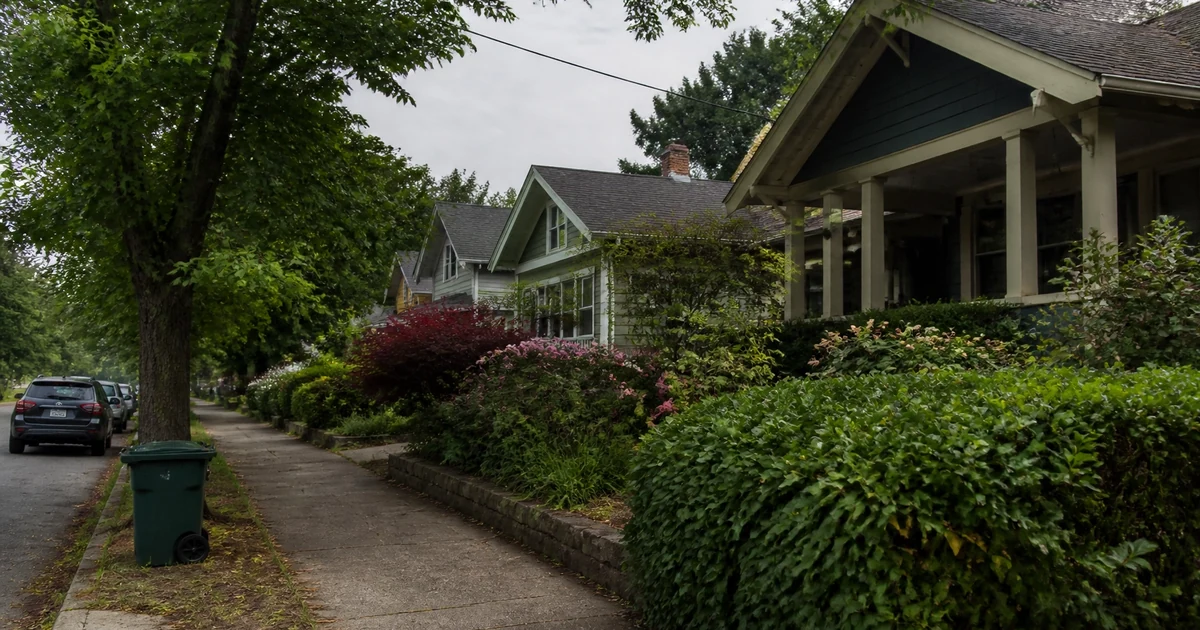
Tree-lined residential street with craftsman homes, Portland, Oregon
An inner Southeast Portland street in early June. Established neighborhoods continued to draw steady buyer interest through spring.

The defining feature of May was the widening gap between buyer activity and seller activity. Buyers showed up in force: pending sales of 2,439 rose 6.1% from last May and 3.5% from April. Sellers pulled back. New listings of 3,246 fell 11.1% from a year ago and 4.4% from April. When more buyers chase fewer new listings, the market tightens even if prices have not yet caught up. That is exactly what the May data shows.

Inventory tells the same story. At 3.2 months, supply held essentially flat with last May's 3.3 months and stayed well below a balanced market of five to six months. Inventory is not building. Combine steady-to-tightening supply with rising demand, and the recent softness in the median price reads less like a downturn and more like a pause before the summer selling season.

+ Continue reading: Full market analysis Pending sales have risen year over year every month in 2026, and the average price now sits $77,300 above the median, pointing to strength at the top of the market.

The demand story runs deeper than a single month. Pending sales have outpaced last year every month of 2026, up 5.5% year to date and accelerating to 6.1% in May. Closed sales follow with a lag, so a strong pending number tends to show up as stronger closings in June and July. The pipeline heading into summer is larger than a year ago.

The price picture is more nuanced. The monthly average reached $637,300, up 2.1% year over year, while the median was $560,000, down 1.7%. That $77,300 gap is wide and points to strength at the upper end, where higher-priced homes make up a larger share of sales. The submarket data confirms it: W Portland and Lake Oswego both posted strong gains this month.

The rate environment is the bridge connecting all of this. Mortgage rates spent May in the low-to-mid 6% range, roughly half a point below a year ago. Lower borrowing costs are pulling buyers off the sidelines, which shows up first in showings and pending sales, then later in closings and prices.

Source Convergence: Portland Prices Holding Near Flat

The RMLS read of a near-flat to slightly lower median lines up with the consumer platforms. Both Zillow Portland home value trends and Redfin Portland market data show values roughly flat over the past year, pointing the same direction as the RMLS data. Treat these as supporting evidence; the RMLS Market Action Report remains the primary source.

Data Point: May Trend Summary
  • Inventory: held at 3.0 to 3.2 months from March through May
  • Pending Sales: up 6.1% year over year in May, up 5.5% year to date
  • Median Price: up 1.8% from April, down 1.7% from last May
  • Market Time: down from 63 to 57 days month over month

Buyer Activity: Showings Hit a 2026 High

Here is a data point no other agent's market report includes. Lockbox showing activity across the Portland Metro area reached 74,804 in May, the highest monthly total of 2026. That is up 3.7% from last May and up 1.8% from April. Showing data is one of the earliest signals of buyer intent, because it measures how many times agents physically opened a lockbox to tour a home. When showings climb, offers tend to follow.

This month the signal is clean and confirming, not contradictory. Showings rose, pending sales rose 6.1%, and closed sales rose 1.7%. Buyers are not just looking, they are writing offers and closing. That alignment matters, because there are months when showings rise but closings stall, signaling hesitation. May 2026 was the opposite: activity moved through the full funnel from tour to contract to close.

+ See the full showing data breakdown Year-to-date showings are up 10.0% over 2025, running ahead of the 2.4% rise in closings and pointing to a deep pipeline of demand for summer.

The year-to-date picture is the most telling part. Through May, total showings are up 10.0% over 2025, while closed sales are up only 2.4%. When showing activity runs that far ahead of closings, it usually means a large pool of active buyers is still working through the process, a supportive signal for closed sales in the months ahead.

For context, the long-run May average over the past decade, excluding the unusual 2020 figure, sits near 79,800 showings. So while May 2026 was the strongest month of this year, it still tracks below the longer historical norm. That is the honest headwind: demand is firm and improving, but it is not the frenzy of the 2017 to 2021 era, when May routinely topped 85,000 showings. This is a healthy, recovering market, not an overheated one.

The forward read: showings accelerating into late spring, combined with pending sales up 6.1%, suggests June and July closings should stay ahead of last year. Buyers who waited for rates to ease appear to be acting on it.

Want to See What Is Actually Selling?

Browse current Portland Metro listings, or reach out and I will walk you through what the data means for your situation. No pressure, no obligation.

Where We Are Now: The Affordability Math

Couple walking up to the front porch of a home, Portland, Oregon
Buyers touring a mid-priced home in the Portland Metro area. Lower rates have improved monthly affordability even with prices near flat.

Here is the math that explains why buyers are moving. On the May median-priced home of $560,000 with 20% down, financing about $448,000 at the prevailing 30-year fixed near 6.4% works out to roughly $2,790 a month in principal and interest. Taxes, insurance, and maintenance are additional. A year ago, the median home of $569,500 at roughly 6.85% cost about $3,025 a month. So even with prices near flat, the typical monthly payment is down roughly $200 from last year. That is real money, and it is the quiet engine behind rising pending sales.

+ Read more: How affordability is trending A Portland family earning the median income of $124,100 can now afford 98% of the payment on a median-priced home, per the RMLS Affordability Index.

The RMLS Affordability Index, updated quarterly, puts hard numbers on this. A family earning the area median income of $124,100, per HUD median family income data, can afford 98% of the payment on a median-priced home, assuming 20% down and a 6.1% rate. That is close to fully affordable by the index definition, and it has been improving as rates ease.

The trend matters more than the snapshot. As tracked by the Freddie Mac Primary Mortgage Market Survey, the 30-year fixed has held in the low-to-mid 6% range through spring, down from the high 6% range a year ago. With prices flat and income roughly keeping pace, the affordability equation has tilted modestly toward the buyer for the first time in a couple of years. That does not make homes cheap, but it makes the monthly number more manageable.

What This Means for Buyers

If you are a buyer, this is a window worth understanding. Prices are flat to slightly lower than a year ago, rates have eased, and inventory at 3.2 months still gives you room to be selective without a bidding-war market. The catch is that demand is rising and new listings are falling, so the leverage you have today may not last through summer. The best-priced, best-condition homes are still moving quickly, with total market time at 57 days metro-wide and much faster in the strongest neighborhoods.

Win Strategy: Current Buyer Conditions

Conditions favor a prepared buyer who acts with intention. You are in a strong position if you:

  • Are fully pre-approved and ready to move when the right home appears
  • Plan to stay in the home at least five to seven years, which rides out short-term price moves
  • Have a comfortable down payment and a monthly budget with room to spare
  • Are watching a specific neighborhood and can recognize fair value when it lists
+ When this advice doesn't apply Buyers with unstable income or a short time horizon should think twice, even in a firming market.
Important: When This Advice Does Not Apply

A firming market does not make buying right for everyone. If your income is uncertain, particularly if you work in a sector seeing layoffs, hold off until your situation stabilizes. If you may need to move within two to three years, the transaction costs of buying and selling can outweigh any near-term gain in a flat-price market. And if buying would stretch your budget to the limit with no cushion, the smarter move is to keep saving and wait. The market will still be here.

What This Means for Sellers

Sellers have a real advantage right now that is easy to miss. With new listings down 11.1% year over year, you face less competition than a seller did last spring. Buyer demand is rising, showings are at a 2026 high, and well-prepared homes are selling in under two months. But the flat-to-slightly-lower median is the reality check: this is not a market where you can overprice and wait. Price to the current market, invest in presentation, and be flexible on terms, and you can sell well this summer.

+ When this advice doesn't apply If your home is in a softening submarket or needs significant work, the strategy shifts.
Important: When This Advice Does Not Apply

Not every seller benefits from listing this month. If your home sits in one of the softer west-side submarkets where median prices slipped year over year, you may need to price more conservatively or wait for stronger comparable sales. If your home needs significant repairs, today's buyers, while active, are still price-sensitive and will discount heavily for deferred maintenance. And if you do not have to sell, weighing your timeline against where rates and inventory may head later this year is a conversation worth having before you list.

Sub-Market Spotlight: A Tale of Two Sides

Aerial view of suburban Beaverton and Washington County, Oregon
Suburban Washington County from above. The 15 Portland Metro submarkets moved in different directions this month.

The metro average hides a real split this month. Inner Portland neighborhoods and the high end posted strong annual price gains, while several west-side suburbs softened. Here are five submarkets that tell the story. Use the expander below the table to see all 15.

Area Median Price YoY Price Closed Sales YoY Sales
SE Portland $525,000 +12.9% 254 0.0%
W Portland $745,000 +12.0% 209 +9.4%
NE Portland $535,000 +2.4% 185 -8.0%
Lake Oswego / West Linn $905,600 +5.6% 134 +24.1%
Beaverton / Aloha $518,900 -6.5% 154 +3.4%
Swipe to see more columns
+ View all 15 Portland Metro sub-markets Oregon City and Canby pending sales jumped 29.3% year over year, the strongest demand signal of any submarket this month.
Area Median Price YoY Price Closed Sales YoY Sales
N Portland $500,000 +6.5% 83 -2.4%
NE Portland $535,000 +2.4% 185 -8.0%
SE Portland $525,000 +12.9% 254 0.0%
Gresham / Troutdale $479,400 -2.1% 138 +7.0%
Milwaukie / Clackamas $550,000 -3.2% 186 +6.3%
Oregon City / Canby $590,000 0.0% 99 -5.7%
Lake Oswego / West Linn $905,600 +5.6% 134 +24.1%
W Portland $745,000 +12.0% 209 +9.4%
NW Washington Co. $722,000 +1.6% 107 +20.2%
Beaverton / Aloha $518,900 -6.5% 154 +3.4%
Tigard / Wilsonville $599,000 -3.4% 185 -11.9%
Hillsboro / Forest Grove $515,000 -1.6% 165 +6.5%
Mt. Hood $523,500 +10.2% 6 0.0%
Columbia Co. $480,000 +3.5% 55 -3.5%
Yamhill Co. $485,000 +2.1% 93 -10.6%
Swipe to see more columns

A few patterns stand out. Inner Portland strength is real: SE Portland led the metro at plus 12.9% and posted the fastest market time at 33 days. The high end is firm, with W Portland up 12.0% and Lake Oswego up 5.6% on a 24.1% jump in closed sales. The softer spots cluster on the west side, where Beaverton and Aloha slipped 6.5% and Tigard and Wilsonville eased 3.4%. Worth watching: Hillsboro and Forest Grove pending sales fell 14.4%, the weakest demand reading in the metro, consistent with ongoing employment pressure in that corridor. You can explore Portland Metro communities to dig into the area that matters to you.

Inventory in Months: The Three-Year View

Inventory is the clearest measure of supply and demand balance. Here is how 2026 has tracked against the current year so far, with the full three-year comparison behind the expander.

Month 2026
January 4.3
February 3.6
March 3.0
April 3.1
May 3.2
+ View the 3-year inventory comparison May inventory of 3.2 months sits just below last year's 3.3 and well under a balanced market of five to six months.
Month 2024 2025 2026
January 3.2 3.7 4.3
February 2.8 3.2 3.6
March 2.3 3.0 3.0
April 2.4 3.1 3.1
May 2.3 3.3 3.2
June 2.6 3.6 n/a
July 2.8 3.7 n/a
August 3.0 3.5 n/a
September 3.5 3.8 n/a
October 2.9 3.1 n/a
November 3.0 3.8 n/a
December 2.7 2.9 n/a

The pattern is steady. After a higher-than-usual January at 4.3 months, inventory settled into the 3.0 to 3.2 range for the spring, almost identical to 2025 and still far below the five to six months that defines a balanced market. Supply is not piling up, which is the structural reason prices have stayed resilient despite higher rates over the past two years.

Joe's Take

When showings and pending sales both climb while new listings drop, that is usually the market telling you what summer will look like before the closing numbers catch up. I am watching the pipeline, not just the price line.

— Joe Saling

Curious What Your Home Is Worth Today?

With listings down and demand rising, this is a good moment to understand your home's current value. Get a no-obligation valuation, or let's talk through whether now is your window to sell.

Where We're Going: What to Watch

Mortgage rates and the June Fed meeting. Rates held in the low-to-mid 6% range through May. The Federal Reserve meets June 16 and 17, and after holding steady at its last three meetings, any shift in tone could move rates either direction. Lower rates would pour more fuel on the demand already building.

Summer inventory. New listings fell 11.1% year over year in May. If sellers stay on the sidelines through summer while buyer demand holds, the supply and demand imbalance tightens further, which would support prices into the fall.

Intel and the west-side economy. Intel's ongoing workforce reductions in Hillsboro and Washington County remain the region's biggest local headwind, and the softness in west-side submarkets this month is consistent with that pressure. This is the one trend that could pull demand below the metro trend in specific areas.

+ See all factors to watch Oregon's 2026 legislature added roughly $100 million in housing bonds and streamlined permitting for large projects.

Oregon housing legislation. The 2026 short session produced roughly $100 million in housing bonding authority and measures to fast-track permitting and tax incentives for large developments, several effective in early June. More supply could ease price pressure over time, though the near-term effect is small. The state's 2019 ADU-by-right framework also keeps accessory dwelling units a practical option for adding value or rental income.

National market context. The S&P Cotality Case-Shiller index showed national prices up just 0.8% year over year in March, the weakest pace since 2023, with Western markets under the most pressure. Notably, Seattle led the 20-city declines. Portland's near-flat median makes it a relative outperformer against several West Coast peers.

Construction costs and the next RMLS report. Material and permitting costs continue to pressure new construction and renovation budgets, with the new permit-streamlining measures a possible partial offset over time. The clearest near-term test: whether June data turns May's strong pending sales into stronger closings, confirming the firming trend has staying power.

Frequently Asked Questions

 
Is June 2026 a good time to buy a home in Portland?+
It can be a good window. Prices are flat to slightly lower than a year ago, mortgage rates have eased into the low-to-mid 6% range, and inventory at 3.2 months gives buyers room to be selective. But demand is rising and listings are falling, so that leverage may not last through summer.
How much have Portland home prices changed?+
The Portland Metro median sale price was $560,000 in May 2026, down 1.7% from $569,500 a year earlier but up 1.8% from April. Year to date, the median is down 1.6% from 2025. The average sale price rose 2.1% year over year, signaling strength at the upper end of the market.
What does 3.2 months of inventory mean?+
Inventory in months is how long it would take to sell every active listing at the current pace of sales. At 3.2 months, Portland Metro sits well below the five to six months that defines a balanced market, which means conditions still modestly favor sellers despite flat prices.
Which Portland neighborhoods are the strongest right now?+
In May 2026, SE Portland led with a 12.9% annual median price gain and the fastest market time at 33 days. W Portland rose 12.0% and Lake Oswego and West Linn gained 5.6% on a 24.1% jump in closed sales. Inner Portland and the high end outperformed this month.
Which Portland areas are softening?+
Several west-side suburbs eased in May 2026. Beaverton and Aloha slipped 6.5% year over year in median price, and Tigard and Wilsonville eased 3.4%. Hillsboro and Forest Grove saw pending sales fall 14.4%, the weakest demand reading in the metro, consistent with local employment pressure.
How have mortgage rates affected affordability?+
Lower rates have helped. On the May median home with 20% down, the typical monthly principal and interest payment is around $2,790, roughly $200 less than a year ago when rates were higher. With prices near flat, the monthly cost of buying has become more manageable than it was in 2025.
Will Portland home prices rise or fall the rest of 2026?+
No one can predict prices with certainty. But with new listings down 11.1%, pending sales up 6.1%, and inventory tight, the supply and demand balance leans toward steady-to-firmer prices into summer. The main risks are a jump in mortgage rates or further job losses in the west-side tech sector.

Let's Talk About Your Next Move

Whether you are buying, selling, or just want to understand what this market means for you, I am here to help. Education first, no pressure, no surprises.

Homes for Sale in Portland

Browse current listings across the Portland Metro area.

Data Sources and References (as of June 2026)

Portland Metro housing statistics from the RMLS Market Action Report, May 2026 reporting period. Showing activity from RMLS SentriLock lockbox data.

Mortgage rates from the Freddie Mac Primary Mortgage Market Survey. Income benchmarks from HUD median family income data.

National price context from the S&P Cotality Case-Shiller Home Price Index. Oregon policy context from Housing Oregon and regional employment reporting from KGW. Directional corroboration from Zillow and Redfin.

Data verified: June 2026

Joe Saling

Real Estate Advisor | Saling Homes at eXp Realty

Joe Saling has been helping Portland-area buyers and sellers for 10 years, backed by 20+ years in sales, marketing, and leadership. He specializes in the Portland Metro market with a focus on data-driven decisions and client education. His approach: educate first, advocate always.

(503) 910-7364 | joe@sellingpdxhomes.com | sellingpdxhomes.com | About Joe

Saling Homes at eXp Realty is committed to equal housing opportunity. We do not discriminate on the basis of race, color, religion, sex, handicap, familial status, or national origin.

GET MORE INFORMATION

Joe Saling

Joe Saling

+1(503) 910-7364

Agent | License ID: 201213671

Agent License ID: 201213671

Name

Name

Phone*

Phone

Message