Cost to Downsize in Portland: What You Will Actually Spend
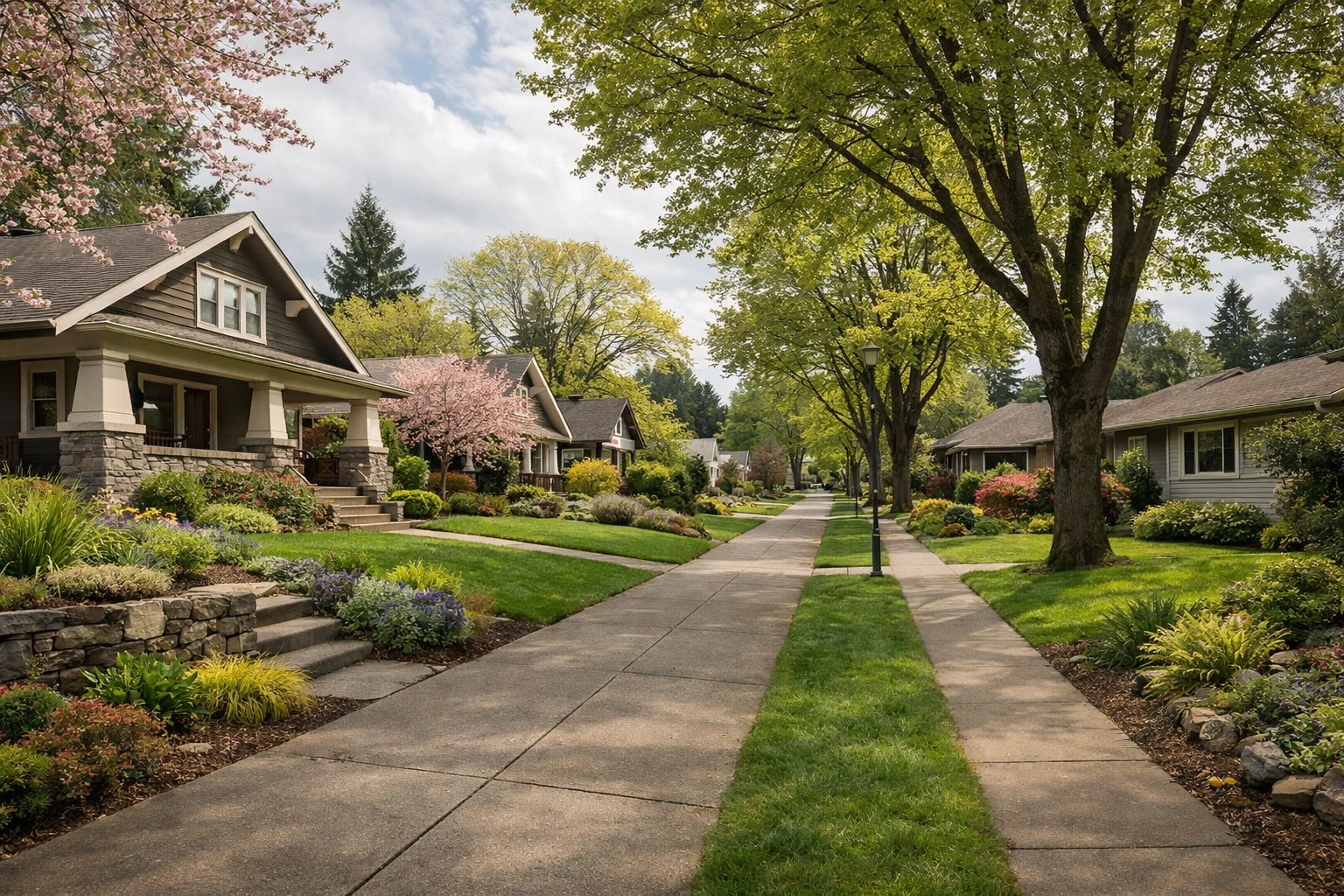
A tree-lined residential street in the Portland metro area, Oregon. Many homeowners in neighborhoods like these are weighing the financial trade-offs of downsizing to a smaller home.
The cost to downsize in Portland is not just the difference between your current home's value and the price of a smaller one. Between selling costs, buying costs, moving expenses, and potential tax implications, the real number can surprise you. This post breaks down every line item so you can build a realistic budget before making a move.
For a typical Portland metro homeowner selling a home around $650,000 and buying one near $425,000, the total cost to downsize runs roughly $55,000 to $75,000 when you factor in agent commissions, closing costs on both sides, staging, moving, and purchase-side expenses. Most homeowners still walk away with significant equity after the transaction, but the gap between your sale price and your net proceeds is wider than most people expect. The key is mapping every cost category before you list, not after.
- The Sell Side: What It Costs to Sell Your Current Home
- The Buy Side: What It Costs to Purchase a Smaller Home
- The In-Between: Moving, Storage, and Transition Costs
- Tax Implications Oregon Downsizers Need to Understand
- Your Net Proceeds Worksheet: Putting It All Together
- Portland Example: A Real Downsizing Cost Scenario
- When This Does Not Apply
- Frequently Asked Questions
The Sell Side: What It Costs to Sell Your Current Home
Selling your home is the first financial event in the downsizing process, and it carries the largest concentration of costs. Here is what to expect in the Portland metro market.
Real Estate Agent Commissions
Agent commissions remain the single largest expense when selling a home. In Oregon, total commissions typically run between 5% and 6% of the sale price, split between the listing brokerage and the buyer's brokerage. On a $650,000 home, a 5% commission totals $32,500. Since the 2024 NAR settlement, the structure of these commissions has shifted. Sellers and buyers now each negotiate compensation with their own agents separately. Many sellers still choose to offer buyer agent compensation to keep their listing competitive, but the exact split is negotiable in every transaction.
Seller Closing Costs
Oregon seller closing costs average approximately 2.42% of the sale price according to 2026 data. On a $650,000 home, that translates to roughly $15,730. The main components include owner's title insurance (which the seller customarily pays in Oregon, typically around $1,350 on a $500,000 sale), half the escrow fee ($800 to $1,000 for the seller's portion), recording fees ($80 to $100 per document), and prorated property taxes for the days you owned the home during the current tax cycle.
One Oregon-specific detail that catches sellers off guard: Washington County is the only county in Oregon that charges a real estate transfer tax, set at $1 per $1,000 of the sale price. Multnomah County and Clackamas County currently charge no transfer tax. If you are selling a home in Beaverton, Hillsboro, Tigard, or Tualatin and your sale price is $650,000, that is an additional $650. For more on this, see our post on Oregon transfer tax and what Portland area buyers need to know.
Pre-Sale Prep and Staging
In today's Portland market, preparation matters more than it did during the pandemic frenzy. With inventory rising and buyers gaining leverage, a well-staged home makes a measurable difference. Professional staging in Portland averages around $1,800 for a standard home, according to industry data from the National Association of Realtors. Vacant homes cost more to stage (roughly $3,000 to $6,000) since furniture needs to be rented. If your home is occupied, a stager can often work with your existing furniture and add accent pieces for less.
Beyond staging, budget for pre-sale repairs and cosmetic updates. For a larger home, this commonly includes interior painting ($3,000 to $6,000 for a full interior), carpet cleaning or replacement in high-traffic areas ($500 to $2,000), landscaping refresh for curb appeal ($500 to $1,500), and a pre-listing inspection ($400 to $600) to identify issues before buyers do. For specific projects that deliver the strongest return, see our guide to home improvements with the highest ROI before selling and the proven staging steps to boost offers.
| Cost Category | Estimated Range |
|---|---|
| Agent commissions (5%-6%) | $32,500 - $39,000 |
| Seller closing costs (~2.42%) | $15,000 - $16,500 |
| Staging | $1,800 - $4,000 |
| Pre-sale repairs and prep | $2,000 - $8,000 |
| Transfer tax (Washington County only) | $0 - $650 |
| Total sell-side costs | $51,300 - $68,150 |
The Buy Side: What It Costs to Purchase a Smaller Home

Most people focus on the sell side when they think about the cost to downsize in Portland, but the buy side carries its own set of expenses that add up quickly.
Buyer Closing Costs
Buyer closing costs in Oregon typically range from 2% to 5% of the purchase price, depending on your loan type, down payment, and which services you select. On a $425,000 purchase, that means $8,500 to $21,250. The main items include loan origination fees (usually 0.5% to 1% of the loan amount), appraisal ($500 to $700), home inspection ($400 to $600), title insurance for the lender, and prepaid escrow for property taxes and homeowners insurance.
Down Payment Considerations
If you are buying your next home with cash from your sale proceeds, you avoid mortgage-related closing costs entirely, which saves significantly. Many downsizers in the Portland metro are in exactly this position: they have enough equity in their current home to pay cash or put down a very large down payment on the smaller property. If you are financing, your down payment is not technically a "cost" since it becomes equity, but it is still cash you need to have available at closing. On a $425,000 home with 20% down, that is $85,000.
HOA Fees and Condo Costs
If you are downsizing into a condo or a community with a homeowners association, the monthly HOA fee becomes a new recurring expense. In the Portland metro, condo HOA fees typically run $300 to $400 per month. In luxury buildings with elevators and concierge services, they can exceed $1,000. Single-family home HOAs are less common and usually much lower, typically $200 to $300 per year if they exist at all. This is an ongoing cost that directly affects your monthly budget, so factor it into your long-term math, not just your closing costs. Our post on choosing the right smaller home covers how to evaluate these trade-offs in detail.
If you are selling a higher-priced home and buying a lower-priced one, you may be able to pay cash for the new home. This eliminates the loan origination fee, lender's title insurance, PMI, and mortgage interest over the life of a loan. Even if you choose to finance a portion, a large down payment dramatically reduces your closing costs and your monthly payment. Work with a lender before you list to understand your post-sale buying power.
The In-Between: Moving, Storage, and Transition Costs
The costs that fall between selling and buying are the ones most people underestimate. These are real expenses that deserve their own line items in your budget.
Professional Moving Costs
Local movers in Oregon charge between $1,231 and $3,262, with most homeowners paying around $2,230 for a standard local move, according to Angi's 2026 data. For a larger home with more belongings, expect to land on the higher end of that range. Long-distance moves (over 100 miles) run $2,700 to $10,000 depending on distance and load weight. If you need packing services, add another $500 to $1,500.
Decluttering and Donation Costs
Downsizing means getting rid of things, and that process itself has costs. Professional decluttering services in Portland typically run $650 to $1,000 or more. If you are handling it yourself, you still need to account for junk removal ($200 to $600 for a full truckload), donation pickup fees (some organizations charge for large furniture pickup), and potentially a storage unit for the transition period. A standard 10x10 storage unit in the Portland metro runs roughly $100 to $200 per month. For a step-by-step approach to the decluttering process, our Portland downsizing checklist walks through the timeline and decision framework.
Temporary Housing
If your closing dates do not align perfectly, you may need temporary housing. This is more common than people expect. A short-term rental in the Portland area runs $1,500 to $3,000 per month depending on location and size. Even a two-week gap between closings can cost $750 to $1,500 in temporary living expenses, plus the inconvenience of moving twice. Negotiating a rent-back agreement with your buyer (where you stay in the home for a set period after closing) can eliminate this cost entirely.
A couple in Tigard sold their 3,200 square foot home and bought a 1,600 square foot ranch in Sherwood. Their transition costs included $2,800 for movers, $800 for junk removal, $400 for two months of a storage unit, and $1,200 for a two-week rental during the gap between closings. Total: $5,200. They had budgeted $2,500. The lesson: double your initial estimate for transition costs.
Tax Implications Oregon Downsizers Need to Understand

Taxes are the cost category that most downsizers either ignore entirely or worry about more than they need to. Here is how it actually works in Oregon.
The Federal Capital Gains Exclusion
The IRS allows homeowners to exclude up to $250,000 in capital gains from the sale of a primary residence (single filers) or $500,000 (married couples filing jointly). To qualify, you must have owned and lived in the home for at least two of the five years before the sale. These 24 months do not need to be consecutive. If your gain falls within these limits, and most Portland downsizers' gains do, you owe zero federal capital gains tax on the sale. Consult a qualified tax professional to confirm your specific eligibility.
Oregon State Capital Gains Tax
This is where Oregon differs from states like Washington, which has no income tax. Oregon does not have a separate capital gains tax rate. Instead, capital gains are taxed as ordinary income under the state's progressive system, with rates ranging from 4.75% to 9.9%. Any gain that exceeds the federal exclusion is added to your other Oregon taxable income for the year and taxed at your marginal rate. For most primary residence sellers who qualify for the full federal exclusion, there is no state tax on the sale either. But if your gain exceeds the exclusion (which can happen if you have owned a Portland home for 20 or more years and it has appreciated significantly), the Oregon tax bite can be substantial. A CPA who understands Oregon real estate transactions can help you plan for this before you list.
Your "basis" is what you originally paid for the home, plus the cost of any capital improvements you have made over the years (new roof, kitchen remodel, added bathroom). Your capital gain is the sale price minus your basis, minus your selling costs. Keeping records of home improvements can significantly reduce your taxable gain. For example, if you bought your Portland home for $300,000, spent $80,000 on improvements over the years, and sell for $700,000, your gain is $320,000 ($700,000 minus $380,000 basis), not $400,000. For a married couple, that $320,000 gain falls well within the $500,000 exclusion.
Property Tax Changes
Oregon's property tax system is unique because of Measure 5 and Measure 50. Your current home's assessed value (which determines your property tax bill) is likely well below its current market value, since annual increases are capped at 3%. When you buy a new home, the assessed value resets closer to the purchase price. This means your property taxes on a $425,000 home could be higher than what you were paying on your $650,000 home that you have owned for 15 years. This is not a one-time cost, but it is a recurring budget change that catches many Portland downsizers off guard. For more details on how property tax deductions work in Oregon, see our guide to Portland homeowner tax deductions for 2026.
If you have owned your Portland home for a decade or more, your assessed value is almost certainly well below market value. When you buy a new home, the assessed value resets. Run the numbers on both properties before assuming downsizing will lower your property tax bill. In some cases, it does. In others, particularly if you are moving from a long-held home in Multnomah County to a recently built home in Washington County, your annual property tax could actually increase.
Your Net Proceeds Worksheet: Putting the Cost to Downsize in Portland Together
Here is a consolidated view of every cost category. Use this as a worksheet to plug in your own numbers.
| Cost Category | Typical Range | Your Estimate |
|---|---|---|
| SELL SIDE | ||
| Agent commissions | 5% - 6% of sale price | |
| Seller closing costs | ~2.42% of sale price | |
| Staging | $1,800 - $4,000 | |
| Pre-sale repairs and prep | $2,000 - $8,000 | |
| Transfer tax (Wash. Co. only) | $1 per $1,000 of sale | |
| BUY SIDE | ||
| Buyer closing costs | 2% - 5% of purchase price | |
| Down payment (equity, not a cost) | Varies | |
| Home inspection | $400 - $600 | |
| IN-BETWEEN | ||
| Moving costs | $1,231 - $3,262 | |
| Decluttering and junk removal | $200 - $1,600 | |
| Storage | $100 - $200/month | |
| Temporary housing | $0 - $3,000 | |
| TAX | ||
| Capital gains tax (if applicable) | $0 for most primary residences | |
| Property tax adjustment (ongoing) | Varies by assessed value | |
To calculate your net proceeds: start with your expected sale price, subtract your remaining mortgage balance, subtract all sell-side costs, then subtract in-between costs. The result is the cash you have available to put toward your next home and any remaining transition expenses.
Portland Example: A Real Downsizing Cost Scenario
A couple sells their 2,800 square foot Craftsman in Sellwood-Moreland for $685,000. They have a remaining mortgage of $180,000 and have owned the home for 18 years. They buy a 1,400 square foot ranch in Milwaukie for $410,000 with cash from the sale proceeds.
Sell-side costs: $34,250 commission (5%) + $16,577 closing costs (2.42%) + $2,500 staging + $4,200 pre-sale repairs = $57,527
In-between costs: $2,600 movers + $500 junk removal + $200 storage (1 month) = $3,300
Buy-side costs: $0 mortgage-related fees (cash purchase) + $1,200 title and escrow + $500 inspection = $1,700
Tax: $0 (gain of approximately $225,000 falls within the $500,000 married exclusion)
Total cost to downsize: $62,527
Net cash remaining: $685,000 - $180,000 mortgage - $62,527 costs - $410,000 purchase = $32,473 in pocket, plus a paid-off home.
That is the math of a successful downsize. This couple walked away with no mortgage, over $32,000 in cash, and a home that costs significantly less to maintain. But they also spent over $62,000 to make the transition. Without planning, that number would have come as a shock.
If you are considering a similar move, the Portland downsizing checklist provides a step-by-step timeline, and our guide to best places to downsize in Portland covers which neighborhoods and suburbs offer the strongest value for your budget.
When This Does Not Apply
If you are renting, not buying. If your downsizing plan involves selling your home and renting instead of buying, the buy-side costs disappear entirely. Your net proceeds will be higher at closing, but you trade equity and ownership stability for monthly rent payments. The financial math is fundamentally different. See our post on comparing downsizing versus aging in place for a deeper look at that decision.
If your gain exceeds the exclusion. If you are a single filer with more than $250,000 in capital gains or a couple with more than $500,000, you will owe federal and Oregon state taxes on the excess. This is more common in Portland than in many markets, particularly for homeowners who bought before 2010 in appreciating neighborhoods. Consult a CPA before listing.
If you are relocating out of state. Moving out of Oregon eliminates Oregon income tax on your future earnings but does not eliminate Oregon tax on the sale of an Oregon property. Long-distance moving costs also jump significantly, often to $5,000 to $10,000 or more.
If you are selling a distressed property. Homes that need significant repairs before listing have a different cost structure. Pre-sale repair budgets can run $15,000 to $50,000 or more, which changes the net proceeds calculation entirely.
Frequently Asked Questions About the Cost to Downsize in Portland
How much does it cost to sell a house in Portland, Oregon?
The total cost to sell a home in Portland typically runs 7% to 10% of the sale price when you combine agent commissions (5% to 6%), seller closing costs (approximately 2.42%), and pre-sale preparation expenses like staging and repairs. On a $650,000 home, that translates to roughly $45,500 to $65,000. The exact amount depends on your commission agreement, the condition of your home, and whether you are in Washington County where a transfer tax applies.
Do I pay capital gains tax when I downsize in Oregon?
Most Portland homeowners who sell a primary residence will not owe capital gains tax, thanks to the federal exclusion of $250,000 for single filers and $500,000 for married couples filing jointly. You must have owned and lived in the home for at least two of the past five years to qualify. If your gain exceeds the exclusion, Oregon taxes it as ordinary income at rates up to 9.9%. A CPA can help you calculate your basis and determine your exposure before you list.
Is it cheaper to downsize to a condo or a smaller house in Portland?
Condos typically have a lower purchase price than single-family homes in the Portland metro, but they come with monthly HOA fees that can range from $300 to over $1,000 depending on the building and its amenities. Over a 10-year period, $400 per month in HOA fees adds up to $48,000. A smaller single-family home avoids that recurring cost but generally has a higher purchase price and requires you to handle all exterior maintenance yourself. The right choice depends on your budget, lifestyle, and how you want to spend your time.
How much do movers cost in Portland?
Local movers in the Portland area charge between $1,231 and $3,262, with the average coming in around $2,230. The final cost depends on the size of your home, the number of movers required, how much you are moving, and any access challenges like narrow staircases or lack of an elevator. Packing services are usually an add-on that runs $500 to $1,500 extra. Getting quotes from at least three companies is the best way to stay within budget.
Can I downsize and come out ahead financially in Portland?
Yes, most Portland homeowners who downsize walk away with net positive equity even after all transaction costs. The key variable is the price gap between your current home and your next one. The wider the gap, the more cash you retain. A homeowner selling a $700,000 home and buying a $400,000 home will have significantly more cash in pocket than someone selling at $550,000 and buying at $475,000, even though both are downsizing. Running the full net proceeds worksheet before listing gives you the clearest picture.
What are the hidden costs of downsizing that most people miss?
The most commonly missed costs include temporary housing if your closing dates do not align (which can run $1,500 to $3,000), the property tax reset under Oregon's Measure 50 (your new home's assessed value starts higher than your old home's capped value), furniture costs for the new space (your existing furniture may not fit a smaller layout), and the emotional cost of decisions about what to keep, sell, or donate. Budget at least $5,000 beyond your calculated transaction costs for these in-between expenses.
Does Oregon have a transfer tax when selling a home?
Oregon does not have a statewide real estate transfer tax. However, Washington County is the one exception. Sellers in Washington County pay a transfer tax of $1 per $1,000 of the sale price. That means a $650,000 home sale in Beaverton, Hillsboro, Tigard, or Tualatin would incur a $650 transfer tax. Multnomah County and Clackamas County currently charge no transfer tax at all.
How much should I budget for staging before selling a large home in Portland?
Professional staging in Portland averages around $1,800 for a standard occupied home. If your home is vacant, expect to pay $3,000 to $6,000 because the stager needs to rent all furniture and decor. Larger homes with more rooms to stage will land on the higher end. Many listing agents include a staging consultation as part of their service, and some agents cover part or all of the staging cost. Ask about this when you interview agents.
Ready to Map Your Downsizing Costs?
Every downsizing situation is different. The numbers in this post give you a framework, but your specific costs depend on your home's condition, your timeline, your target neighborhoods, and your tax situation. I can walk you through a personalized net proceeds estimate so you know exactly what to expect before you make any commitments.
Data Sources and References (as of March 2026):
- IRS Publication 523: Selling Your Home - Primary residence capital gains exclusion rules
- Oregon Department of Revenue - Oregon income tax rates and capital gains treatment
- National Association of Realtors: 2025 Profile of Home Staging - Staging statistics and market impact
- Angi: How Much Do Movers Cost in Portland, Oregon - Local and long-distance moving cost data
- HomeGuide: Home Staging Cost Guide (2026) - Staging cost ranges by service type
- Washington County, Oregon - Real property transfer tax rate
Data verified: March 2026
The information in this post is for general educational purposes and does not constitute financial, legal, or tax advice. Consult a qualified professional for guidance specific to your situation.
Saling Homes at eXp Realty is committed to equal housing opportunity. We do not discriminate on the basis of race, color, religion, sex, handicap, familial status, or national origin.
Categories
- All Blogs (93)
- Buying a Home (35)
- Community Page (14)
- Downsizing (7)
- Home Buying Process (7)
- Homeownership (6)
- Increasing Your Homes Value (4)
- Local Events (2)
- Market Update (21)
- Mortgage Information (9)
- Neighborhood Eats and Experiences (1)
- neighborhood info (3)
- Real Estate News (15)
- Selling Your Home (20)
Recent Posts







GET MORE INFORMATION